This article contains affiliate links. We may earn a commission from qualifying purchases.
Some content on this site is AI-assisted and reviewed by our editorial team.
Every January it is the same phone call. The second car — the weekend truck, the project sedan, the “we’re keeping the good one running” garage car — sits through the hard freeze, and on the morning someone actually needs it, the starter clicks like a cassette player. A jump or a tow runs about $90, and a battery deep-cycled one too many times ends at a new one for around $200. The fix that beats both costs $50 of gear and plugs in before the first freeze does, and it is smart enough to run safely for months.

The math is the whole pitch: prevention hardware pays for itself the first time one cold morning does not turn into a tow bill, and the setup takes ten minutes. Here is the gear, ranked by who should buy what.
NOCO GENIUS5 — the do-it-all maintainer
NOCO GENIUS5 at $69.95 (4.5 stars, 21,000-plus ratings) is the maintainer I set up for the household’s primary winter worry — five amps is real recovery speed, it charges and then maintains 6V and 12V batteries including lithium, and its thermal compensation adjusts behavior in an unheated garage the way a dumb charger cannot. The desulfation mode is the piece that pulls a January battery back from sulfation’s edge instead of writing it off.
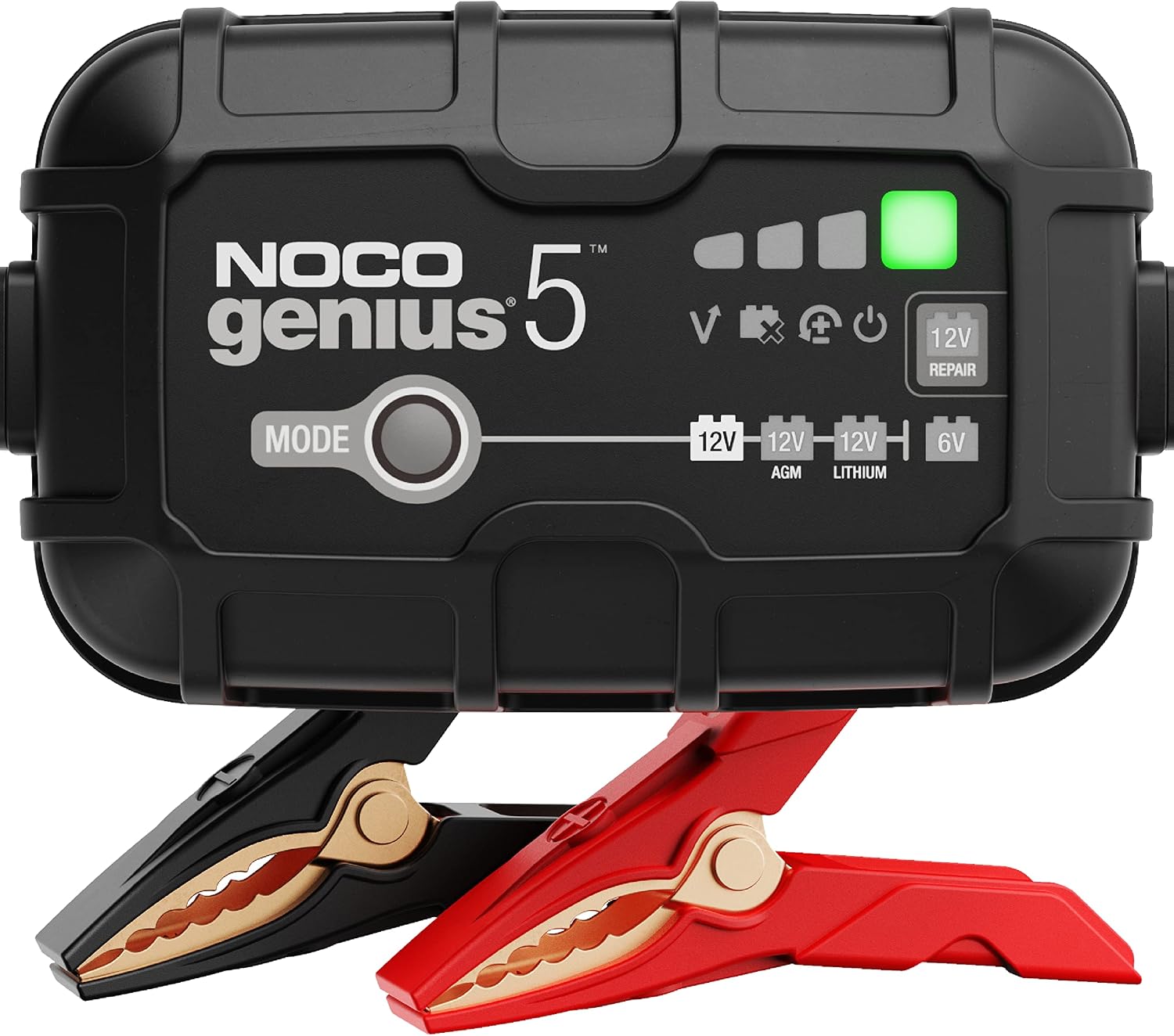
The honest con: $69.95 is roughly double the entry tier, and a sedan battery that gets one winter of sitting does not strictly need five amps. Buy this for the truck, a big AGM bank, or the “one unit for everything the household needs” impulse — it has been NOCO’s steady seller for exactly these reasons.
My take: the buy-once answer — spend the extra twenty and stop thinking about which vehicle needs what this winter.
NOCO GENIUS2 — the 50-dollar slot
NOCO GENIUS2 at $49.95 is the honest “50-dollar maintainer” of this post: two amps of smart charging that maintain any normal car battery through the whole season, 40 amp-hours of capability, the same microprocessor safety as its bigger siblings. It is the exact price point of one tow — buy it once, skip every tow after.
My take: the default winter pick for a sedan or SUV that sits — if the battery has not been deep-cycled yet, two amps is all a season needs.
NOCO GENIUS1 — the 1-amp minimum
NOCO GENIUS1 at $29.95 (4.4 stars, 64,000-plus ratings — Amazon’s perennial budget-charger bestseller) covers the smallest budgets and the smallest batteries: motorcycles, lawnmowers, and a car that gets plugged in every couple of weeks rather than left unattended for a season. One amp maintains; recovering a truly flat battery overnight is where it earns its patience.
My take: the $30 insurance policy — pair it with the timer below and your whole stack lands near $40.
NOCO GENIUS10 — the big-battery unit
NOCO GENIUS10 is the ten-amp option for trucks and AGM banks — overkill for a single sedan, and the price says so plainly. Its real value is speed: a deeply discharged large battery that waits two days on the smaller units recovers in hours. If the tow scenario you fear is the big truck’s, the 10-amp tier is justified.
My take: for the truck-and-tractor household, or an RV bank — everyone else’s money stays in the GENIUS2 slot.
BN-LINK Outdoor Mechanical Timer — the dumb-timer trick
BN-LINK Outdoor Mechanical Timer at about $12 is the cheap-smart crossover this blog exists for: a weatherproof dial timer with 30-minute granularity schedules the maintainer’s duty cycle and caps phantom draw, and it never needs Wi-Fi, an app, or a firmware update. Mechanical timers lose a few minutes a month — irrelevant when a maintenance duty cycle runs in half-day windows.
My take: the $12 add-on that makes the cheap maintainer behave like a whole winter plan — set the dial, forget the garage until March.
Winter-proof your order: chargers, timers, and the cables that go with them add up fast at checkout. A 30-day Prime free trial knocks the shipping off the whole cart — worth it before the next cold snap.
What Actually Saves Money (And What Doesn’t)
Saves: the maintainer + timer stack. Under $80 with the upgrade unit, about $40 with the entry pair, against a single $90 tow plus the shortened battery life a deep discharge causes. One survived cold snap pays the whole bill — the second and third winters are profit.
Saves: thermal compensation. Unheated garages swing 40 degrees in a day; smart chargers adjust float voltage with temperature, dumb ones cook or starve the battery. This is the single feature that separates a maintainer from a trickle charger.
Saves: plugging in before the first freeze. A battery maintained from November still owns full cranking amps in February. A battery rescued in February has already given up capacity it never gets back.
Doesn’t save: the jump box as a plan. A $200-plus jump starter does nothing until the failure happens, and the failure is the thing with the $90 + $200 tail. Prevention beats rescue on price, every winter.
Doesn’t save: old batteries. A battery four-plus winters old may owe nobody a rescue. Test it — most parts stores test free — before you spend $50 of prevention keeping a $200 replacement on life support.
The Annual Cost Math
- No plan: one dead-battery morning per winter, historically — $90 tow, plus the accelerated replacement, $200-ish every three to four years. Call it $150 a year averaged.
- The $50 plan: GENIUS2 at $49.95 (or GENIUS1 + timer near $42, or GENIUS5 for the big rigs at $69.95), one 10-minute setup, phantom draw capped by a $12 timer.
- The result: prevention pays for itself the first winter it works; everything after is a battery that reaches old age with full capacity instead of a rescue story.
The same dial-timer logic that schedules a maintainer also caps the holiday light bill — the timer math for the December bill runs the per-night numbers, and reading the winter utility bill’s phantom-load math covers the standby draws you are also paying for in January.
CleverHomeClub is reader-supported. As an Amazon Associate, I earn from qualifying purchases. That means if you buy through one of the links above, I get a small commission at no extra cost to you. I only recommend devices I’d run in my own home.
🏠 Get Your Free Smart Home Setup Checklist
Join our newsletter and get this free printable plus weekly tips.
Frequently Asked Questions
Is a battery maintainer better than a trickle charger?
For batteries that sit, yes. A microprocessor maintainer charges, then floats and pulses to fight sulfation, while a cheap trickle charger keeps pushing current and can boil the water out of the battery over weeks. The smart unit costs a little more and saves the battery.
Can you leave a battery maintainer on all winter?
Yes, that is the point of a maintainer, and models with temperature compensation are safe in an unheated garage for the season. Never leave a non-smart trickle charger connected unattended for months.
How much does a NOCO Genius cost compared to a tow?
The entry Genius1 runs about 30 dollars, the Genius2 about 50, and the 5-amp Genius5 about 70. Against a typical jump-start or tow fee, plus the shortened battery life caused by deep discharges, one avoided winter dead battery pays for the gear.
What size maintainer does a 6-cylinder car need?
A 5-amp unit like the Genius5 handles a normal car battery with margin, and the 2-amp Genius2 is fine for the same car if you plug it in before the battery gets deeply discharged. Reserve the 10-amp units for big AGM banks, trucks, and fast recovery jobs.
Liked this guide? Get the next one in your inbox — the smart home starter checklist is free too.
✓ You're in — check your inbox.
No spam. Unsubscribe anytime. We never share your email.