This article contains affiliate links. We may earn a commission from qualifying purchases.
Some content on this site is AI-assisted and reviewed by our editorial team.
Millions of American homes heat with electric baseboards, and the smart-thermostat world pretends they don’t exist. Nest and Ecobee are built for forced-air systems with low-voltage control wires — they won’t touch a 240-volt line-voltage baseboard. That leaves millions of bedrooms running dumb dial thermostats that heat to 72 degrees whether anyone’s home or not. Mysa is the only credible smart thermostat for line-voltage heat, and the question isn’t whether it works — it’s whether the $100 LITE or the $160 V2 pays for itself fast enough to matter. I ran the numbers.
The savings claim that gets tossed around is up to 26% on heating costs. That number comes from scheduling — dropping the temperature when you’re asleep or at work instead of heating empty rooms to comfort. The math is straightforward: if a baseboard-heated bedroom costs $40 a month in electricity, a schedule that cuts runtime by 20% saves $8 a month. Over a six-month heating season, that’s $48 — halfway to paying off a LITE in one winter. Here’s the catch nobody talks about before ordering.
Mysa Smart Thermostat LITE for Baseboard — The $95 Entry Point
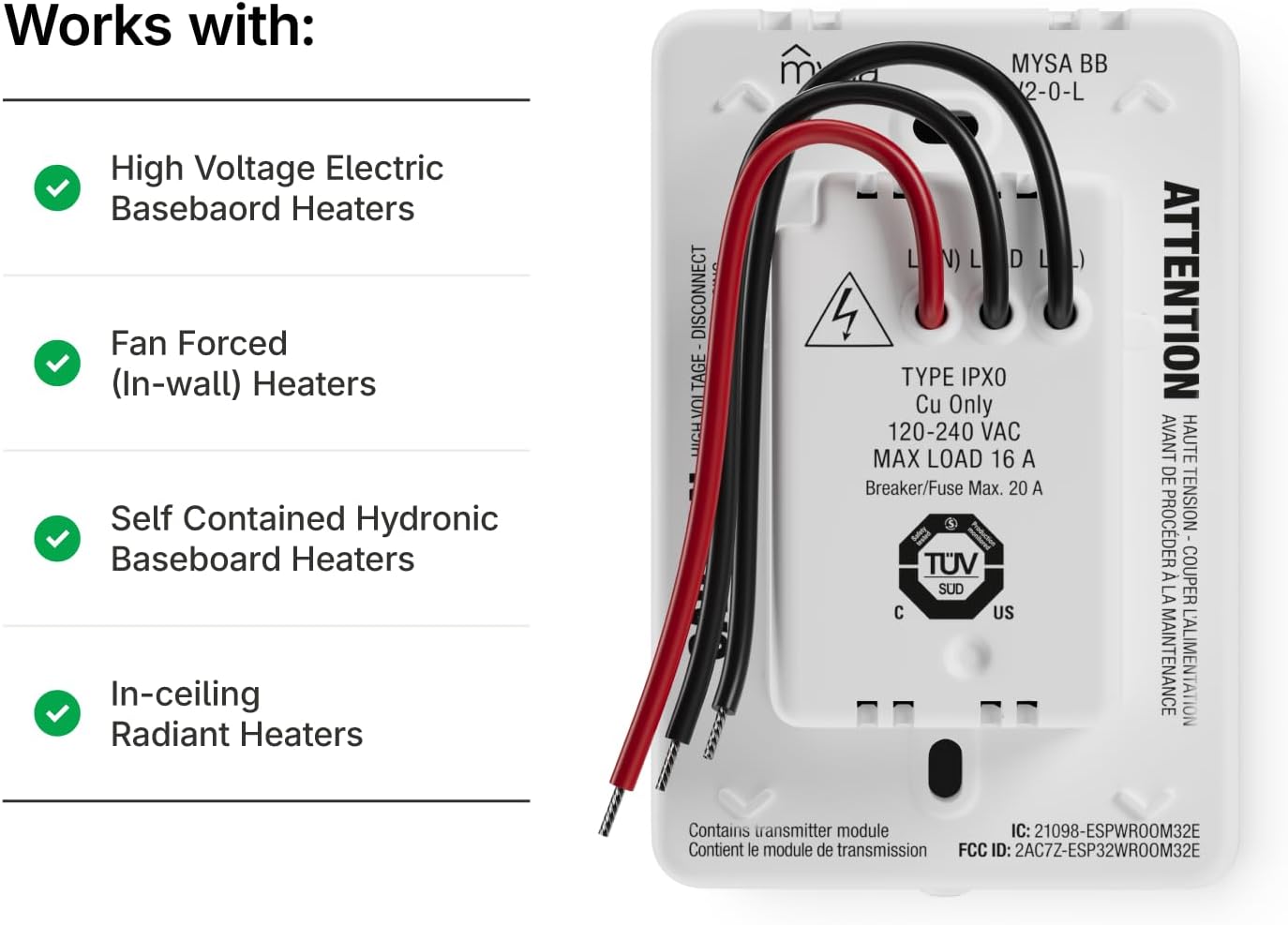
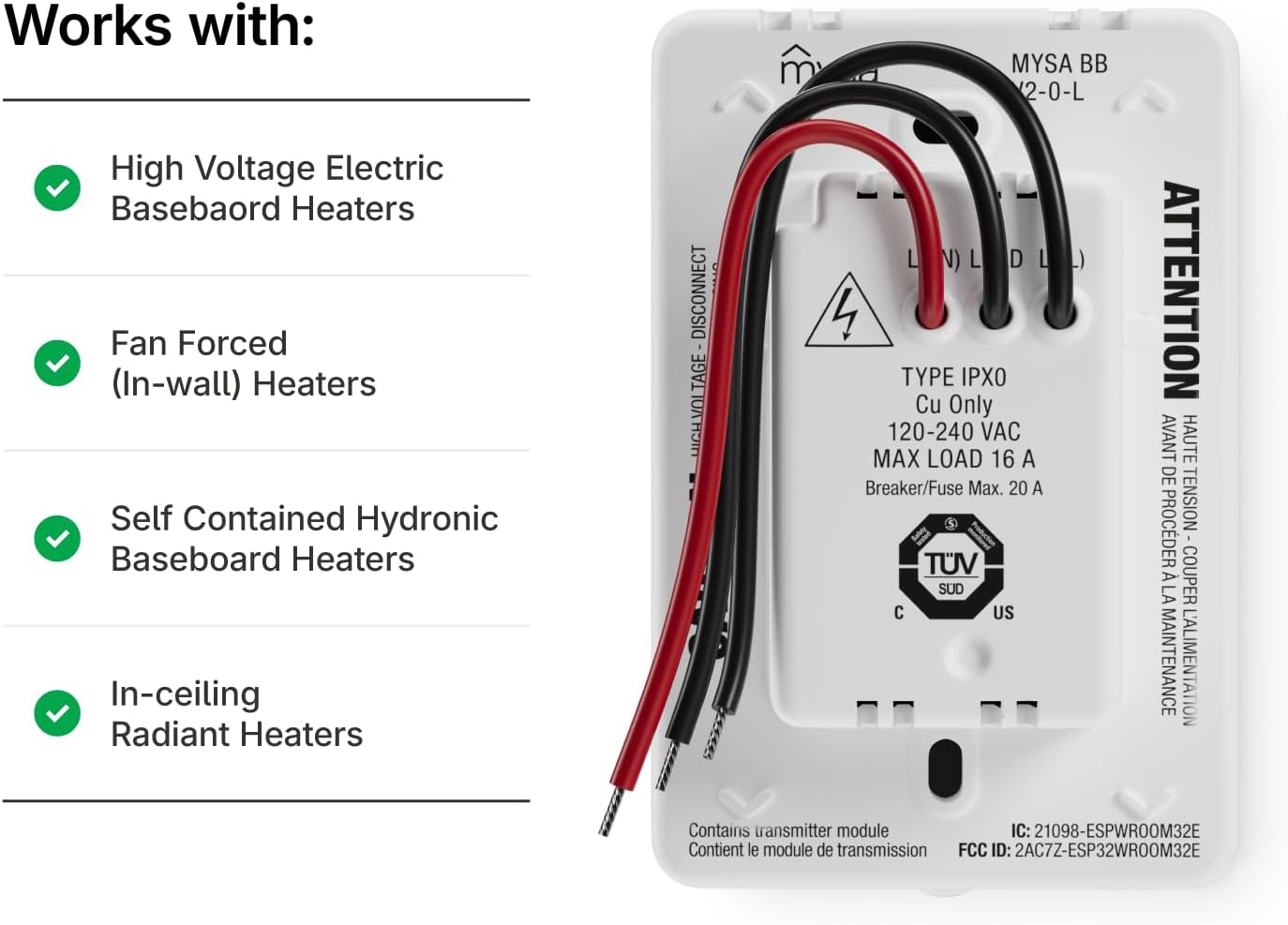
The Mysa LITE is the cheapest schedule-driven savings route for line-voltage baseboard heat. At about $95, it handles scheduling, geofencing, and app control with no monthly subscription — you set the schedule once and it runs. The app is clean, the install is straightforward if you’ve ever swapped a light switch, and it works with Alexa and Google Home for voice control.
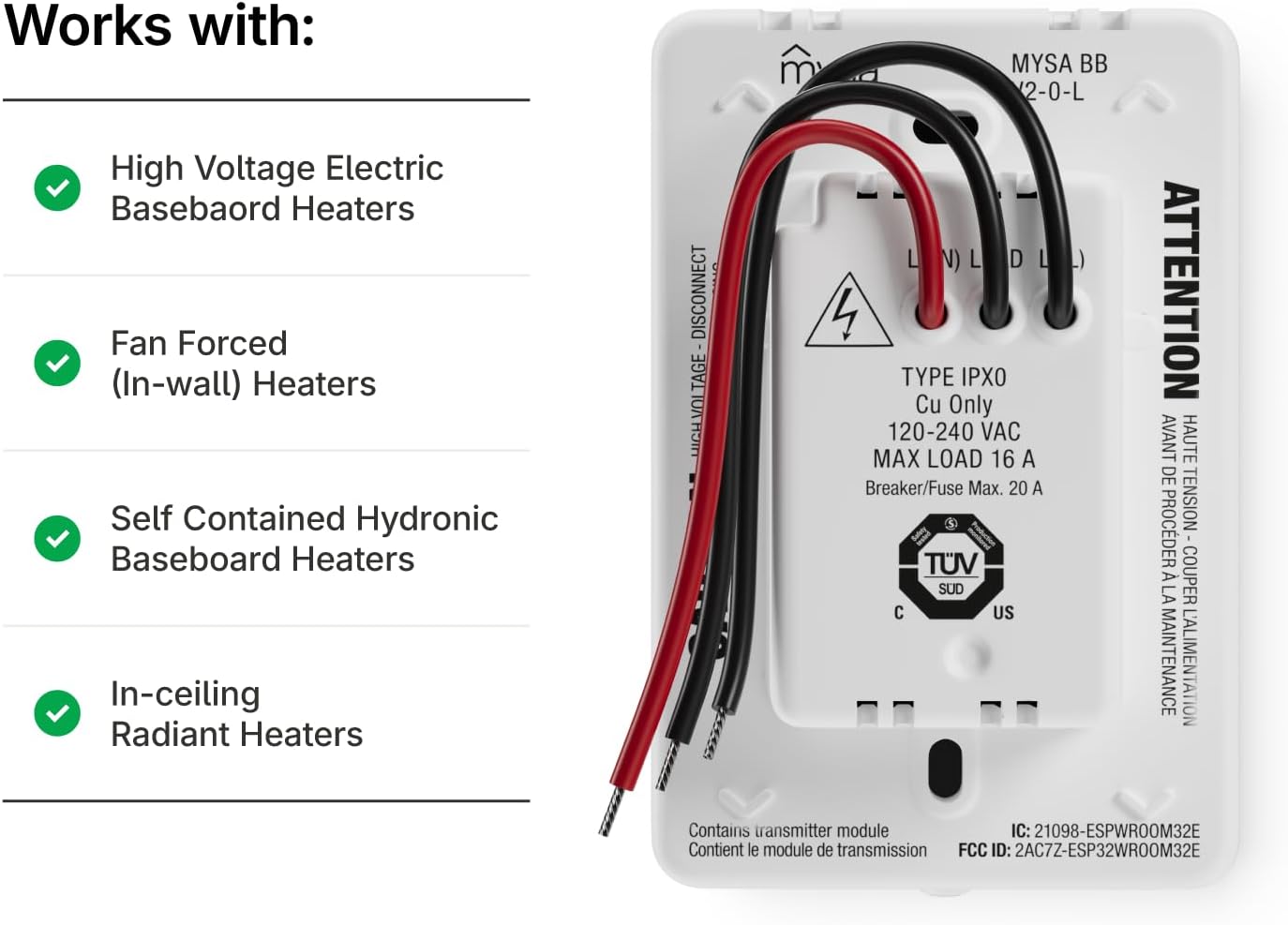
Here’s the catch that kills installs: the LITE needs 4 wires, including a neutral. Many older baseboard installations run 2-wire loops with no neutral at the thermostat — line in, load out, that’s it. If your wall box has only two wires, the LITE won’t work, and you’re looking at an electrician visit to pull new wire. Check your wiring before you order, not after. The LITE also drops the V2’s energy charts and humidity sensor — you get scheduling and app control, but no detailed usage data to verify the savings.
My take: The right pick if your wiring has a neutral and you want schedule savings without paying for energy charts you’ll check twice.
Mysa Smart Thermostat V2 for Baseboard — The Full-Feature Pick
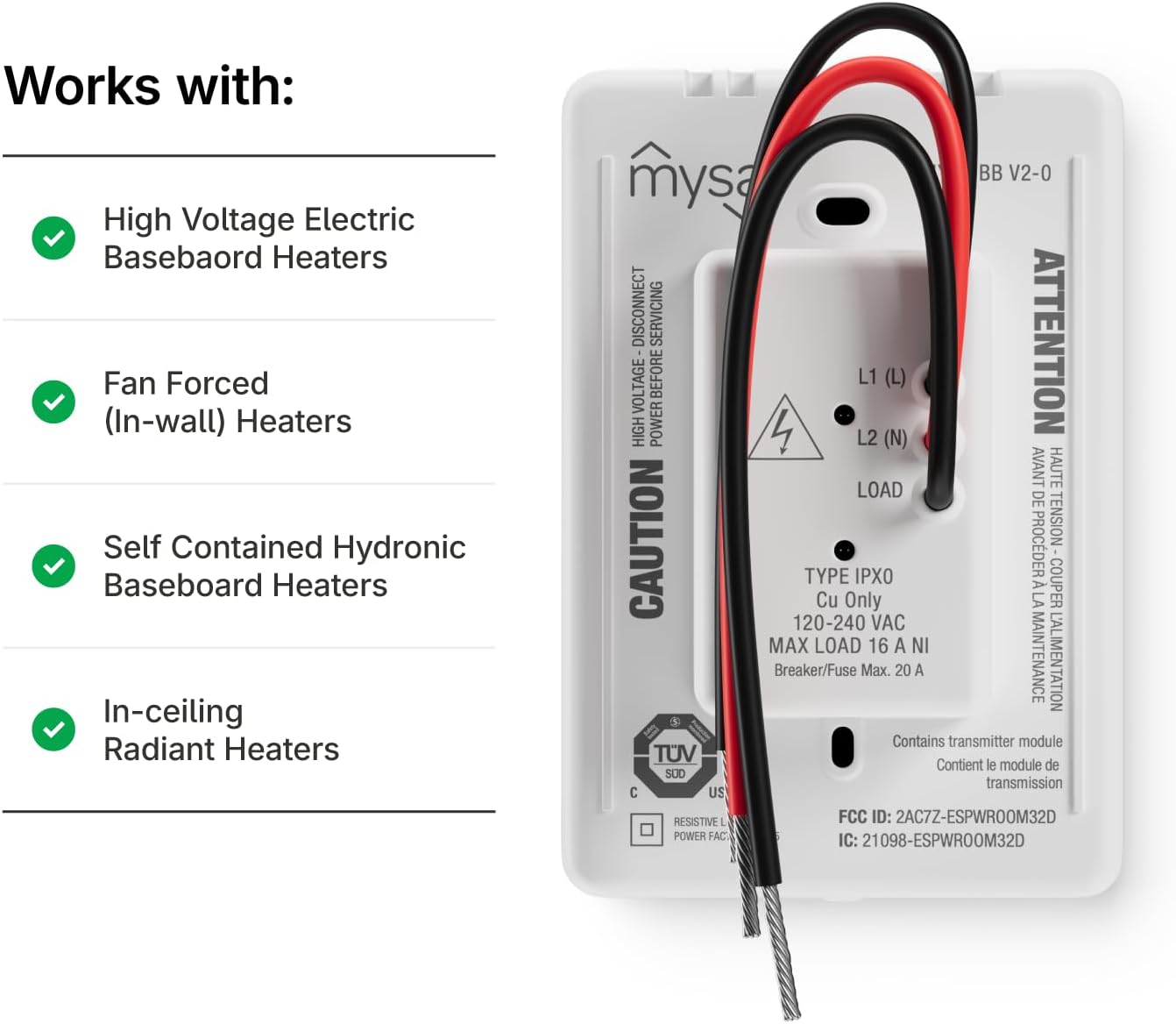
The Mysa V2 adds the features the LITE omits: room-by-room energy charts, humidity sensing, and a touchscreen interface. The energy charts are the real value — they show you exactly how much each room’s baseboard ran yesterday, last week, and last month, which lets you verify the savings instead of guessing. At about $130 to $160, it’s the price of a Nest for a single room.
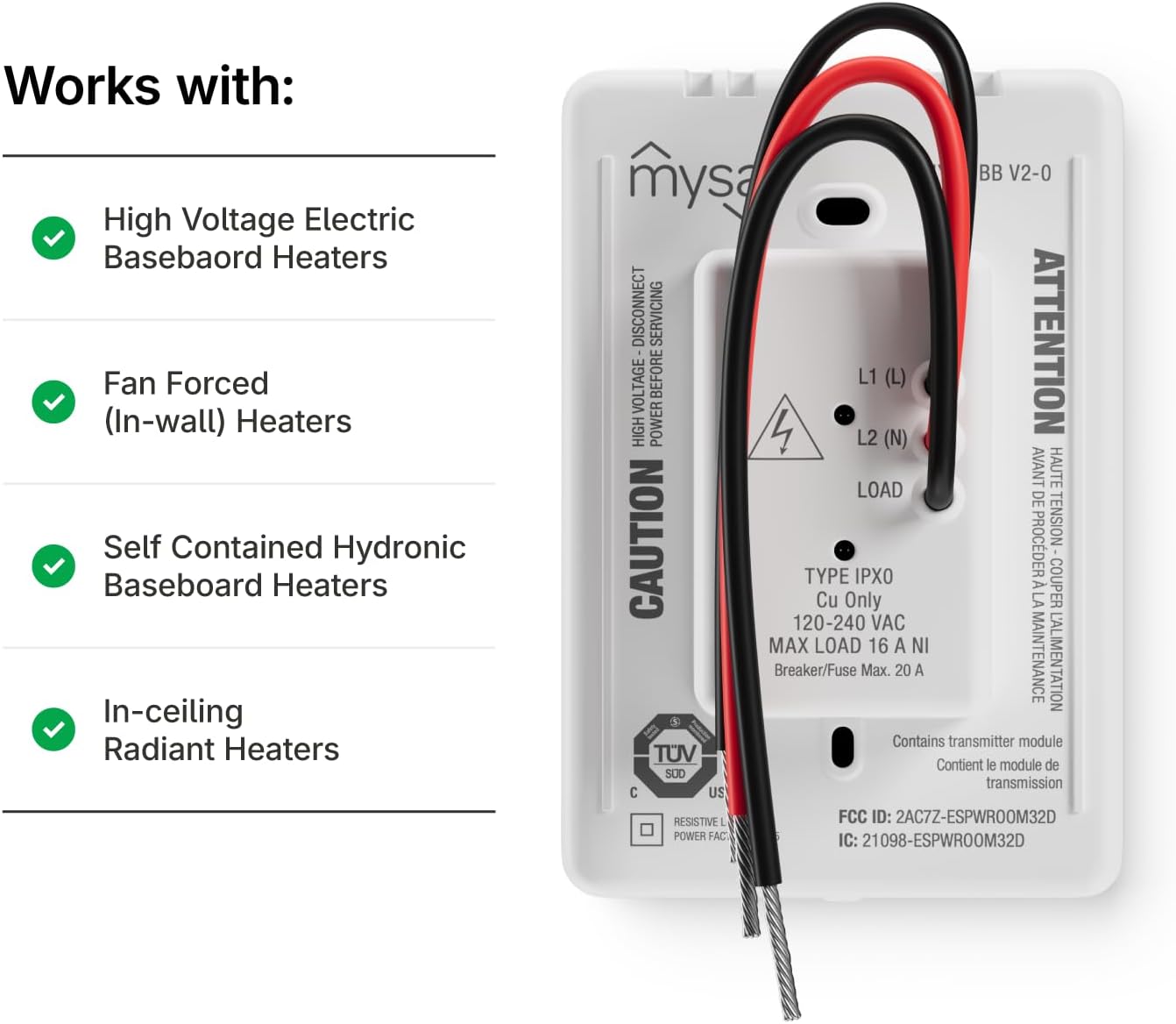
The tradeoff is the same 4-wire requirement — the V2 won’t save you from old wiring. The touchscreen is responsive but small, and the matte-black edition is a limited run that’s hard to find. If you’re outfitting multiple rooms, the price difference between LITE and V2 adds up fast: 4 rooms at $160 is $640 versus $380 for the LITE.
My take: Worth the premium for the room you spend the most time in, where the energy charts actually inform adjustments — use LITE for the rest.
Sinopé Line-Voltage Thermostat — The HomeKit Alternative
Sinopé (sold under the Noiro brand on some sites) is the other credible line-voltage player, and it’s the pick if you’re committed to Apple HomeKit. It offers local control — no cloud dependency — plus energy stats and scheduling in a similar form factor to Mysa. The price is competitive with the V2.
The honest cons: the US support footprint is smaller than Mysa’s, setup is clunkier, and the app isn’t as polished. If you’re not specifically invested in HomeKit or local-only control, Mysa’s ecosystem is more user-friendly. But for the privacy-first household that wants line-voltage smart control without cloud round-trips, Sinopé is the credible alternative.
My take: The right pick if HomeKit or local-only control is a hard requirement — otherwise Mysa’s app experience wins.
The 7-Day Mechanical Timer — The $30 Dumb-Tech Fallback
If your wiring doesn’t support Mysa, or you’re renting and can’t swap thermostats, a plug-in 7-day outlet timer on a portable convection heater captures the same schedule savings for $30. Set it to turn on 30 minutes before you wake and off when you leave — no app, no subscription, no neutral wire. It’s the honest renter fallback.
The tradeoffs: no remote control, no per-room zoning, no energy charts. You set the schedule with physical pins on a dial, and twice a year you manually adjust for daylight saving time. But if the goal is just “don’t heat an empty room all day,” a $30 timer does 80% of what a $95 smart thermostat does.
My take: The renter’s answer — if your landlord won’t let you rewire, this is how you capture schedule savings anyway.
Free shipping on smart-home gear: A Prime free trial gets you free two-day shipping on Mysa and accessories — useful when the cold snap arrives before your order does.
What Actually Saves Money (And What Doesn’t)
Scheduling saves, remote control doesn’t: The 20-26% savings come from the schedule, not from turning the heat down from your phone. If you’d program a $30 mechanical timer the same way, you’d capture most of the savings without the smart thermostat.
Zoning is the real win: Baseboard heat is room-by-room by default — each room has its own thermostat. Smart control lets you set different schedules per room, which is where the savings compound. Heating the bedroom only at night and the living room only during the day is impossible with a single furnace thermostat but trivial with per-room Mysa units.
Geofencing is a nice-to-have: The “heat up when you’re 15 minutes from home” feature is convenient but saves less than a fixed schedule. Don’t buy the V2 for geofencing alone.
Energy charts pay for themselves: The V2’s usage data tells you which rooms are costing the most, which schedules are actually saving, and when a baseboard is running more than it should (a sign of a failing unit or drafty window).
The Savings Math
- One room, $40/month baseboard cost: Schedule saves ~20% = $8/month = $48/season. LITE pays for itself in 2 seasons.
- Three rooms, $120/month total: Per-room scheduling saves ~20% = $24/month = $144/season. Three LITE units ($285) pay for themselves in 2 seasons.
- The 4-wire check: If you need an electrician to pull a neutral wire, budget $100-200 per room. That pushes payback to 3-4 seasons — still positive, but check wiring first.
- The renter route: One $30 mechanical timer on the most expensive room’s portable heater captures the same schedule savings with zero install. Payback: under one month.
Keep reading: For the rest of the closed-window season, our air purifier filter math pairs heating with air quality, and the Thanksgiving hosting guide covers the kitchen side. For whole-home automation, the Echo Show 15 review covers the family-command-center angle.
CleverHomeClub is reader-supported. As an Amazon Associate, I earn from qualifying purchases. That means if you buy through one of the links above, I get a small commission at no extra cost to you. I only recommend devices I’d run in my own home.
🏠 Get Your Free Smart Home Setup Checklist
Join our newsletter and get this free printable plus weekly tips.
Frequently Asked Questions
Can you put a smart thermostat on electric baseboard heat?
Yes, but only a line-voltage thermostat designed for it. Standard smart thermostats (Nest, Ecobee) are built for low-voltage forced-air systems and cannot handle 240V baseboard loads. Mysa is the main option.
Does Mysa really save money on heating?
The savings come from scheduling — dropping the temperature when you are asleep or away. A 20% reduction in runtime on a $40/month room saves $8/month, paying off a $95 LITE in about two heating seasons.
Why does Mysa need 4 wires?
Mysa requires line, load, neutral, and ground. Many older baseboard installations use 2-wire loops with no neutral at the thermostat. Without a neutral, the thermostat has no return path for its own electronics — you would need an electrician to pull new wire.
Liked this guide? Get the next one in your inbox — the smart home starter checklist is free too.
✓ You're in — check your inbox.
No spam. Unsubscribe anytime. We never share your email.
Price Check
Prices verified via our product tracker. Updated Oct 31.
| Mysa Smart Thermostat LITE for Electric Baseboard Heaters | $99.00 | 4.5★ (185) |
| Mysa Smart Thermostat V2 for Electric Baseboard Heaters | | $129.00 | 4.5★ (1,295) |
As an Amazon Associate we earn from qualifying purchases.