This article contains affiliate links. We may earn a commission from qualifying purchases.
Some content on this site is AI-assisted and reviewed by our editorial team.
Two winters ago our water heater’s drain valve let go while we were out, and the $30 leak sensor caught it. The Echo Dot upstairs did its job too — announcing “water leak detected” to an empty house. We saw the phone alert 40 minutes later, $180 of soaked boxes into the event. The sensor worked. The speaker didn’t — a speaker only talks to whoever is standing in front of it. That gap is the entire argument for Amazon’s $180 Echo Hub.
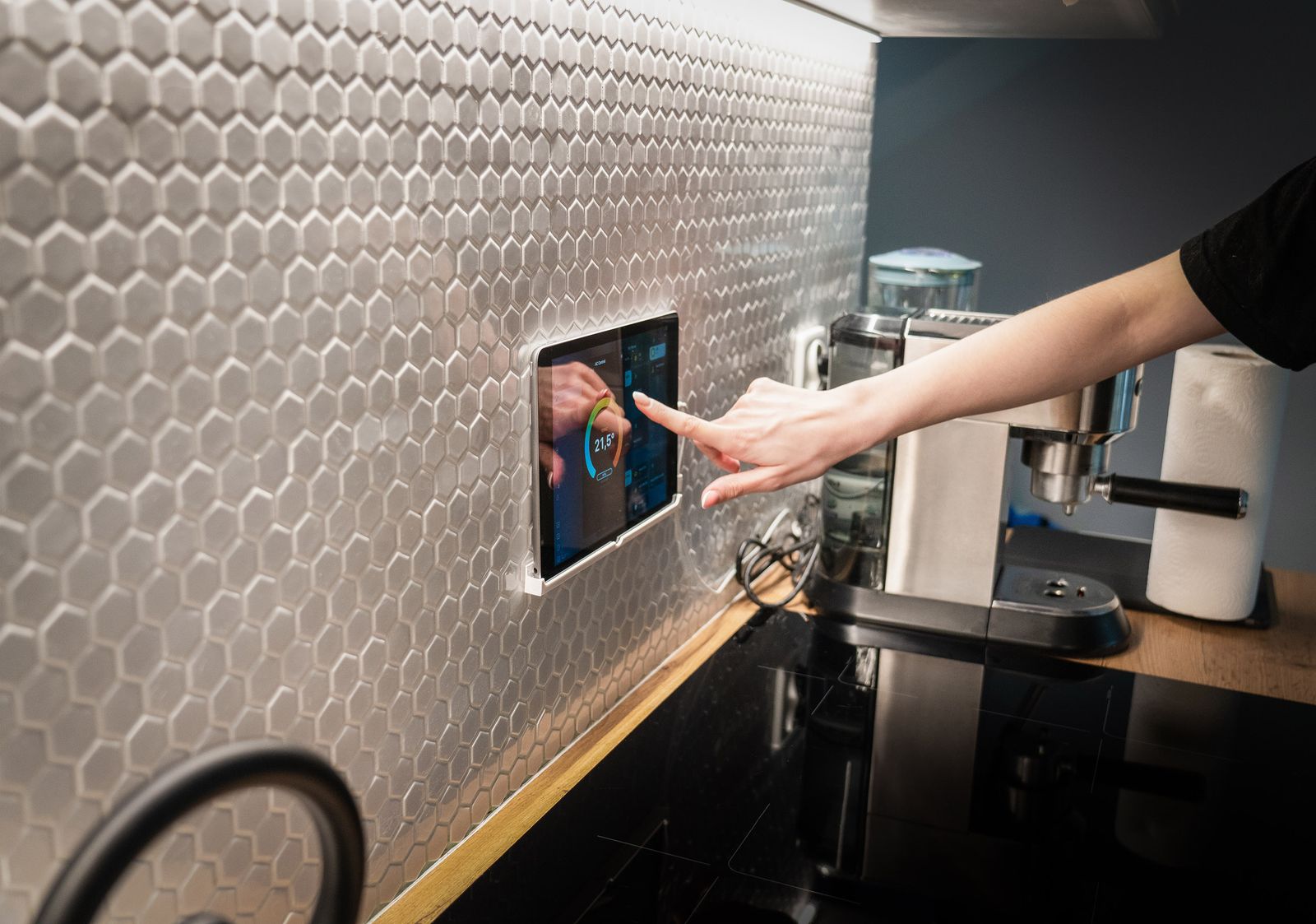
Here’s the comparison Amazon’s lineup doesn’t make easy: the Echo Hub is the company’s only Alexa device built as a wall controller rather than a speaker, and the new Dot Max muddied it by putting hub radios in a speaker for $60 less. I ran all five through two questions — what does it do that a speaker cannot, and what does leaving the platform later cost you.
Amazon Echo Hub — The 8-Inch Wall Controller
The Amazon Echo Hub at about $180 is the only Alexa device that treats the wall as the product: an 8-inch touchscreen with Zigbee, a Thread border router, and Matter built in. What that buys you is glanceable control — four camera feeds on one screen, a dashboard of every lock, thermostat, and light, one tap instead of one voice command. The honest catch: it needs wired power, so you’re either running a cable down the wall to an outlet or paying an electrician $150-300 to hide it — the wall install is on you. It’s also Alexa-only — no Google Home, no Apple Home.
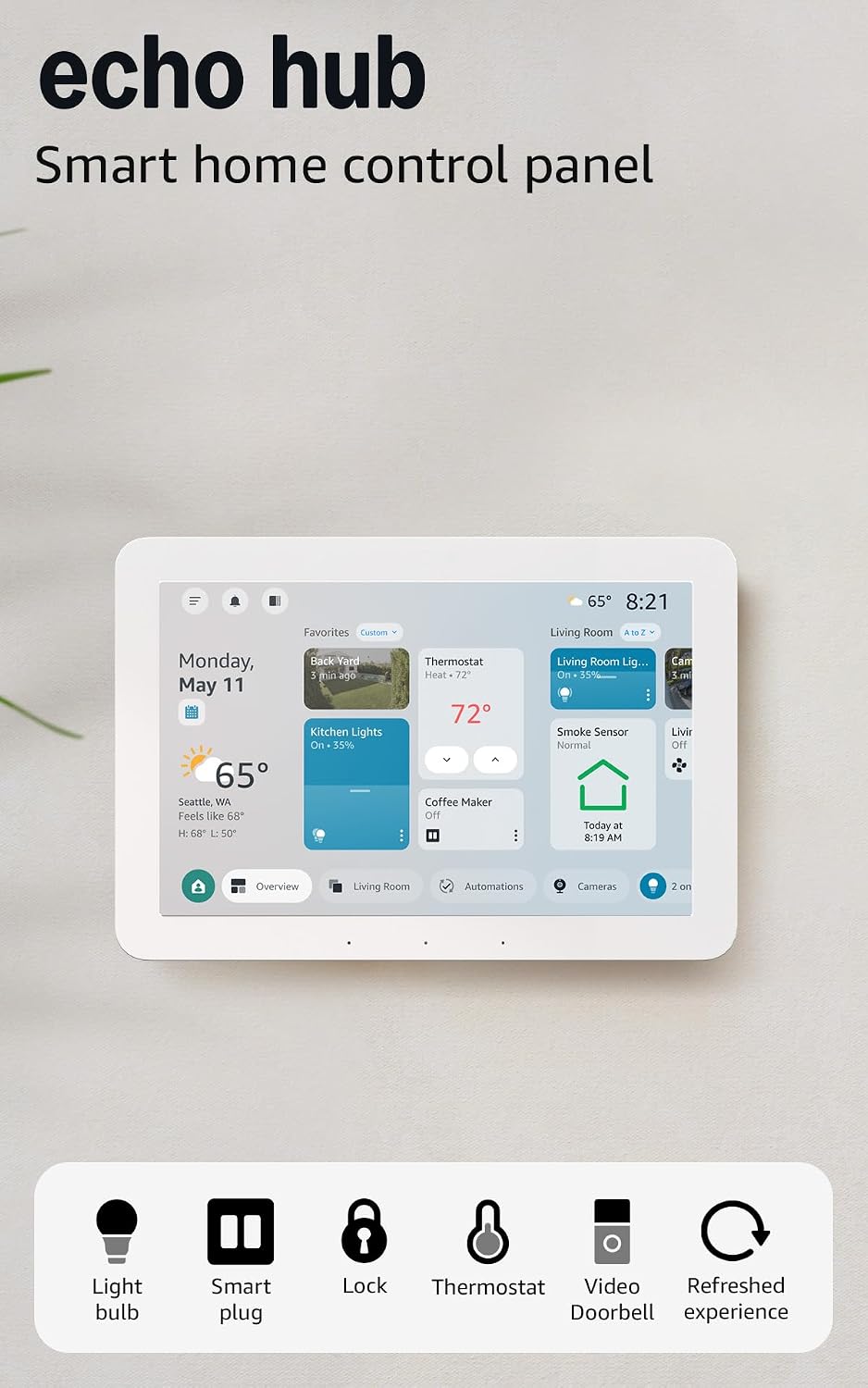
My take: If you run three or more cameras or have ever wanted your whole home on one wall, nothing else in Alexa’s lineup does this. If your smart home is two bulbs and a plug, it’s $180 answering a question nobody asked.
Amazon Echo Dot Max — The 2026 Hub-Plus-Speaker
The Amazon Echo Dot Max at about $120 is the device that complicated this whole comparison. The 2026 refresh adds Zigbee and a Thread border router to a genuinely good speaker — the Hub’s radio stack plus actual music output, for $60 less. It’s the hub for people who want one capable device per room instead of one panel per wall — renter-friendly, plugs into any outlet, asks nothing of your walls. The honest cons: it’s brand-new with thin long-term review history, and there’s no screen — no camera feeds, no dashboards, nothing glanceable. Our Dot Max vs regular Dot breakdown covers the rest of that math.
My take: The best value in the lineup for most Alexa households — hub radios, real audio, no install. It replaces the panel only if you never wanted one.
Amazon Echo Dot (5th Gen) — The Cheapest Entry
The Amazon Echo Dot (5th Gen) at about $50 is the floor of the Alexa hub world. It carries a Thread border router and Matter support, so a small setup — a few Matter bulbs, a plug, a thermostat — runs off it for a quarter of the Hub’s price. The honest limits: no Zigbee — older Zigbee bulbs and sensors need a separate bridge — and the two-inch speaker forwards more than it controls: it can tell you a sensor tripped, but it can’t show you anything. Past 15 or so devices it gets clumsy.
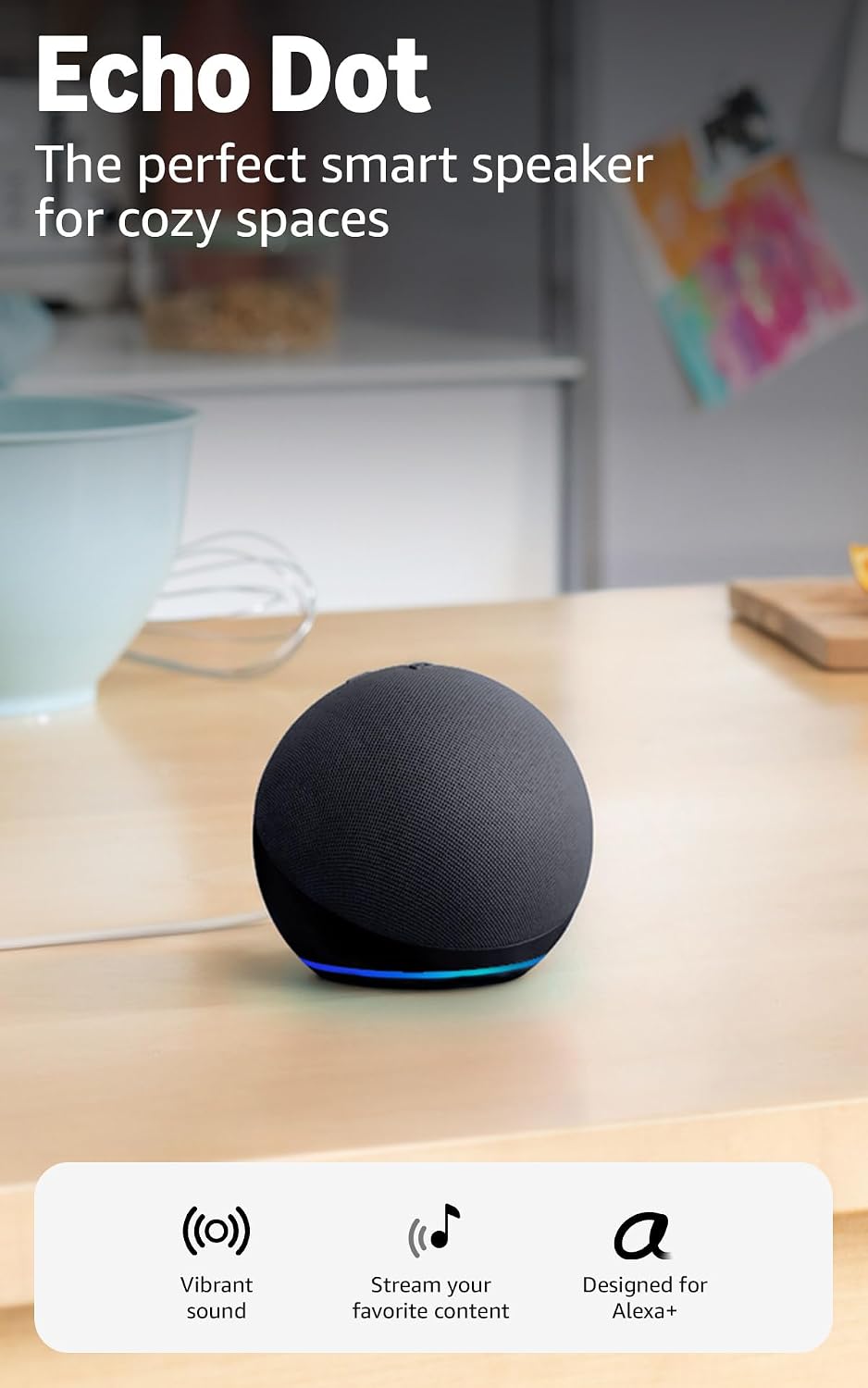
My take: The right first hub if you’re not sure smart home gear will stick — the least you can spend to find out. Upgrade the day you add a camera.
Aqara Smart Home Hub M3 — The Multi-Platform Controller
The Aqara Smart Home Hub M3 at about $160 is the pick for people who refuse to pick. It’s a Matter controller, Thread router, Zigbee coordinator, and IR blaster in one box, loyal to Apple Home, Home Assistant, and SmartThings at once — the opposite of the Hub’s Alexa-only deal. Its automations can run locally, which matters if you’re privacy-conscious or your internet flakes. The honest cons: Aqara’s own sensors get the red carpet while third-party Matter devices are second-class citizens, there’s no power adapter in the box, and no screen at all — this is a brain, not a panel.
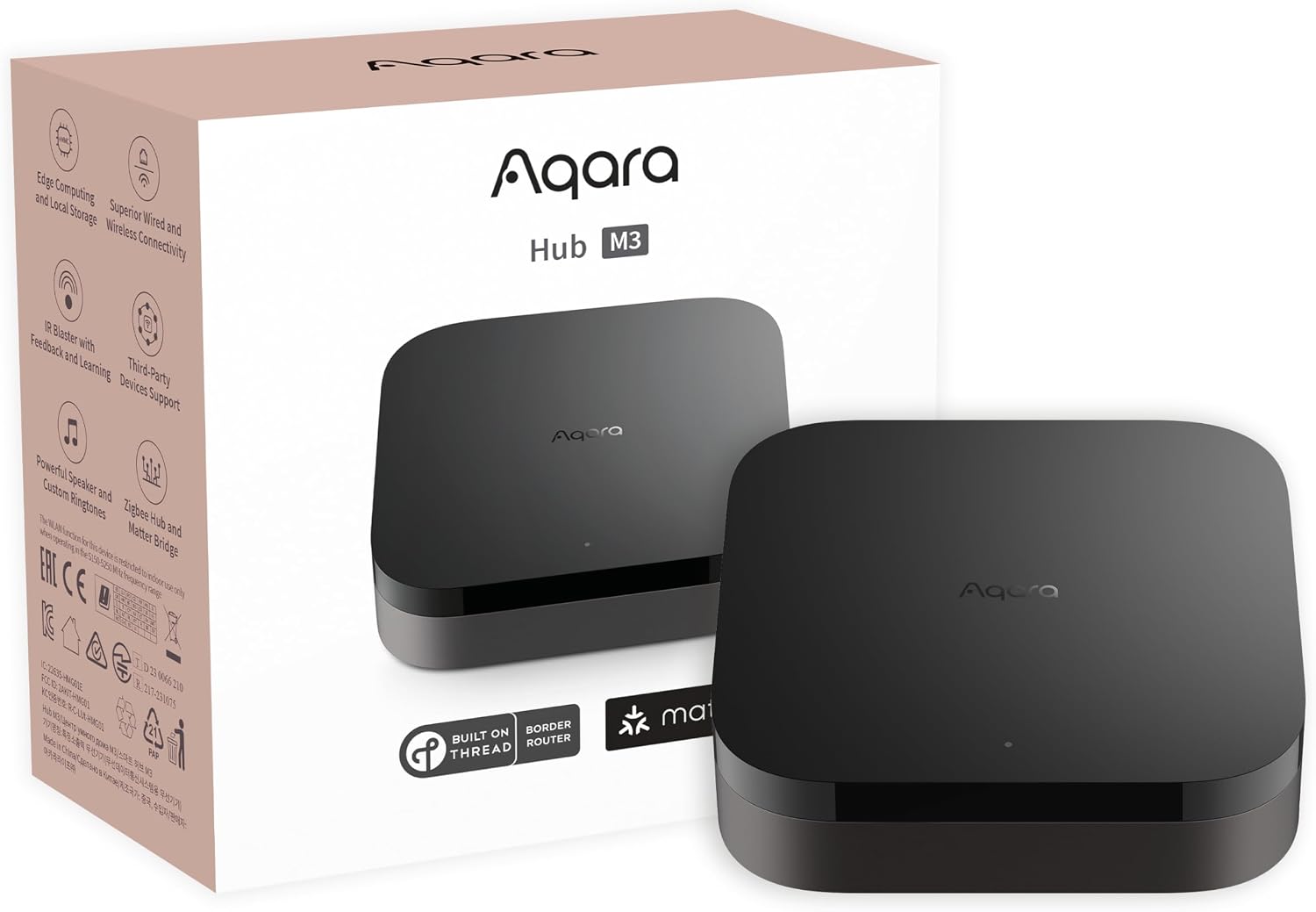
My take: The best hub for Apple Home and mixed-platform households — $160, no subscription, no Alexa required. Skip it if you want the wall screen — the M3 is the engine, not the dashboard.
Home Assistant Green — The Local-Control Exit Ramp
The Home Assistant Green at about $220 is the exit ramp from every ecosystem question on this page. It’s a plug-in box that runs your automations entirely locally — no cloud, no account, no monthly anything, no company that can brick your setup with a policy change. It speaks Matter, Thread, Zigbee (with a dongle), and everything else the closed hubs gate. The honest cons: no radios inside — Zigbee and Thread both want USB dongles at $20-40 extra — and the learning curve is a genuine weekend. It’s also invisible: no screen, no speaker, no wall presence.
My take: The endgame for privacy-first tinkerers who want a weekend project. If flashing a Zigbee coordinator sounds like a chore, buy the Hub or M3 and be done by dinner.
Smart home gear hits its lowest prices around Prime events — grab a free 30-day Prime trial for free shipping and deal alerts on the Echo lineup.
What Actually Saves Money (And What Doesn’t)
Buy Matter, not platforms: Every Matter-certified bulb, plug, and lock here moves to your next hub by scanning one QR code. The $180 panel is replaceable; the $400 of devices hanging off it is the asset — which is why the Hub’s Alexa-only lock-in stings less than it used to.
The panel saves nothing by itself: The Echo Hub doesn’t cut a single bill. It makes a heating schedule and an everything-off check so glanceable you keep using them — consistency is where the money is.
Skip the subscriptions: None of these five hubs charge monthly. The recurring costs live elsewhere — cloud camera plans run $30-60 a year, and a panel showing local feeds makes them optional.
One hub beats five bridges: A controller carrying Zigbee, Thread, and Matter replaces brand bridges at $25-50 each — the Hub and M3 each consolidate three radios, the Green everything.
The Savings Math
Run it on a $1,800 winter heating bill: a schedule you keep — because the wall shows when it drifts — trims roughly 10 percent, call it $150-180 a year. Ditch the cloud camera plan because the Hub shows feeds locally — another $40-60. That’s $190-240 a year against $180 once: the panel clears its own cost in the first heating season. The Dot Max earns the same schedule savings for $120 without the camera math; the Green pays back the same way with zero subscription risk.
The Bottom Line
A wall panel earns its $180 exactly one way: by showing what a speaker can only describe — camera feeds, whole-home dashboards, one-glance status you use every day. If that’s your house, buy the Echo Hub; if not, the Dot Max at $120 delivers the same radios and better sound, and the $60 stays in your pocket. Answer the platform question first: Alexa households get the Hub or Dot line, Apple and multi-platform homes the M3, and the Green is the only one nobody can take away from you.
Keep reading: our Echo Show 15 wall review covers what a bigger screen on the wall really replaces.
CleverHomeClub is reader-supported. As an Amazon Associate, I earn from qualifying purchases. That means if you buy through one of the links above, I get a small commission at no extra cost to you. I only recommend devices I’d run in my own home.
🏠 Get Your Free Smart Home Setup Checklist
Join our newsletter and get this free printable plus weekly tips.
Frequently Asked Questions
Is the Echo Hub worth it over an Echo Show?
If you want a wall-mounted control panel that shows camera feeds, runs dashboards, and controls lights without asking Alexa, the Hub earns its $180. If you mostly want a kitchen screen for recipes and timers, an Echo Show does that for less. The Hub is a controller first; the Show is a smart display first.
Does Echo Hub work without Alexa?
No — the Echo Hub requires an Alexa account and the Alexa app for setup and most automations. It does support Matter and Thread locally, so Matter devices can run some automations without the cloud, but the device itself is Alexa-dependent. If you want full local control without any cloud, look at Home Assistant Green instead.
What is the best smart home hub without a subscription?
For Alexa households: the Echo Hub or Echo Dot 5th Gen both include Zigbee/Thread/Matter with no monthly fee — you only pay for optional cloud camera storage. For multi-platform users: the Aqara M3 works with Apple Home, SmartThings, and Home Assistant with no subscription. Home Assistant Green is the most subscription-proof option but requires the most setup work.
Liked this guide? Get the next one in your inbox — the smart home starter checklist is free too.
✓ You're in — check your inbox.
No spam. Unsubscribe anytime. We never share your email.
Prices move fast. Start your Amazon trip from our Shop & Support page and your purchases support CleverHomeClub at no extra cost to you.
Price Check
Prices verified via our product tracker. Updated Oct 14.
| Amazon Echo Hub 8-inch Smart Home Control Panel | $99.99 | 3.9★ (1,815) |
| Amazon Echo Dot (newest model) - Vibrant sounding speaker | $79.99 | 4.7★ (200,849) |
| Aqara Smart Home Hub M3, Matter Controller and Thread Bord | $159.99 | 4.1★ (1,679) |
As an Amazon Associate we earn from qualifying purchases.