This article contains affiliate links. We may earn a commission from qualifying purchases.
Some content on this site is AI-assisted and reviewed by our editorial team.
You monitor your thermostat, your security cameras, your energy usage. But you probably never monitor the air you breathe. Indoor air can be 2 to 5 times more polluted than outdoor air, according to the EPA. The difference is invisible: dust, pollen, cooking fumes, candle smoke, cleaning chemical vapors, and CO2 buildup from closed windows.
Smart air quality monitors measure these pollutants in real time and trigger automations to fix them. I spent months testing different sensors and building automations around them. Some are worth every penny. Others overlap so much you only need one. Below I walk through what each one does well, where it falls short, and how to wire it into your smart home so the air stays clean without you constantly checking an app.
What to Measure: The 5 Key Pollutants
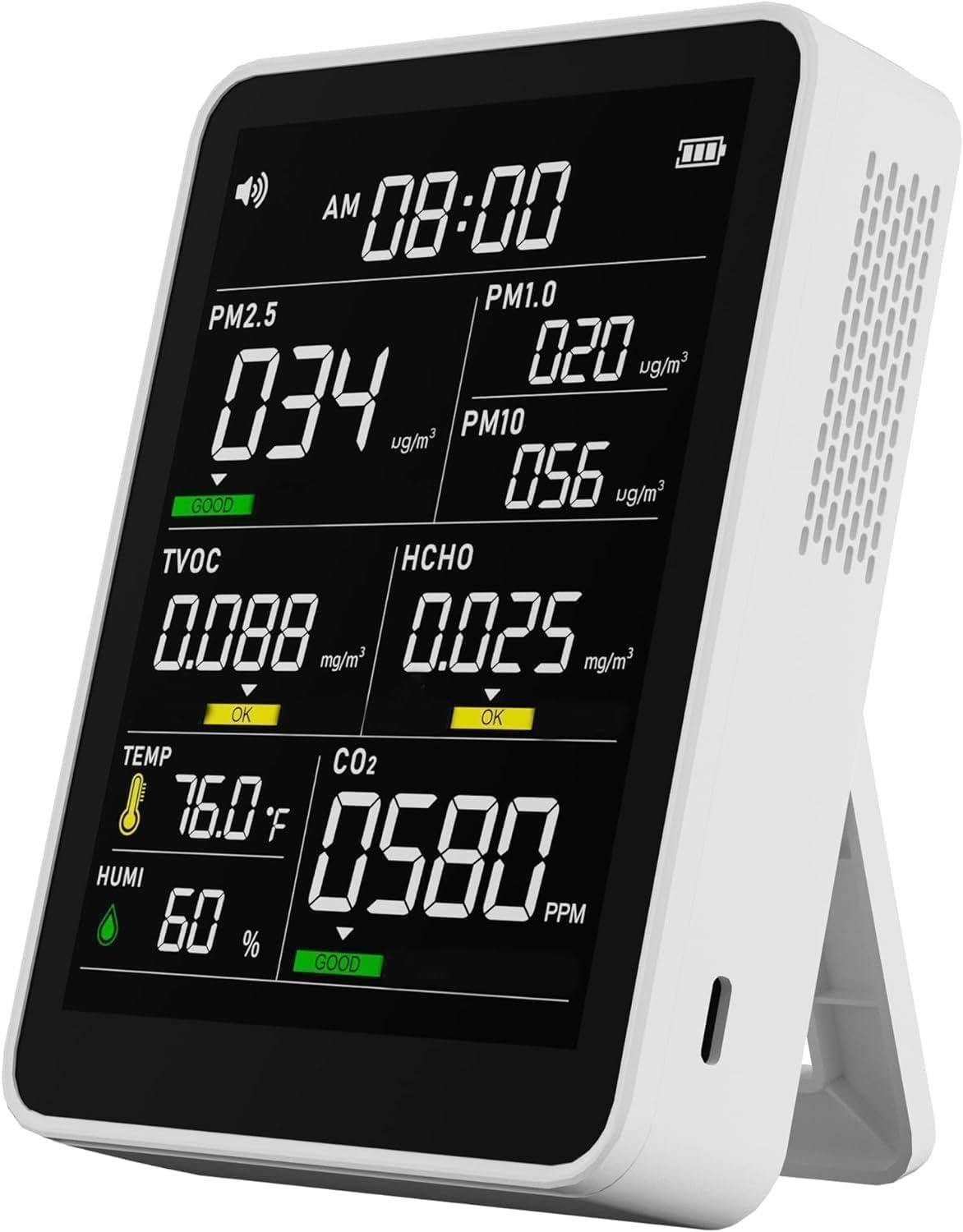
Not all air quality monitors measure the same things. Here are the 5 pollutants that matter most in a home, ranked by health impact:
- PM2.5 (fine particulate matter): The most dangerous pollutant. Particles smaller than 2.5 microns penetrate deep into lungs and enter the bloodstream. Sources: cooking, candles, fireplaces, outdoor air pollution, dust. Long-term exposure reduces lung capacity and increases heart disease risk.
- CO2 (carbon dioxide): Builds up in closed rooms. Causes drowsiness, headaches, and poor concentration at levels above 1000 ppm. In bedrooms, high CO2 directly reduces sleep quality. Sources: breathing, cooking, gas heaters.
- VOCs (volatile organic compounds): Chemical gases from cleaning products, paint, furniture, candles, and cooking. Formaldehyde from new furniture and flooring is a VOC. Some VOCs are carcinogenic with long-term exposure.
- Carbon monoxide: Deadly at high levels. Produced by gas stoves, furnaces, fireplaces, and attached garages. Every home with gas appliances needs a CO detector.
- Radon: Radioactive gas from soil that enters through foundation cracks. The second leading cause of lung cancer after smoking. Cannot be detected without a specific test.
The Awair Element: My Pick for General Monitoring
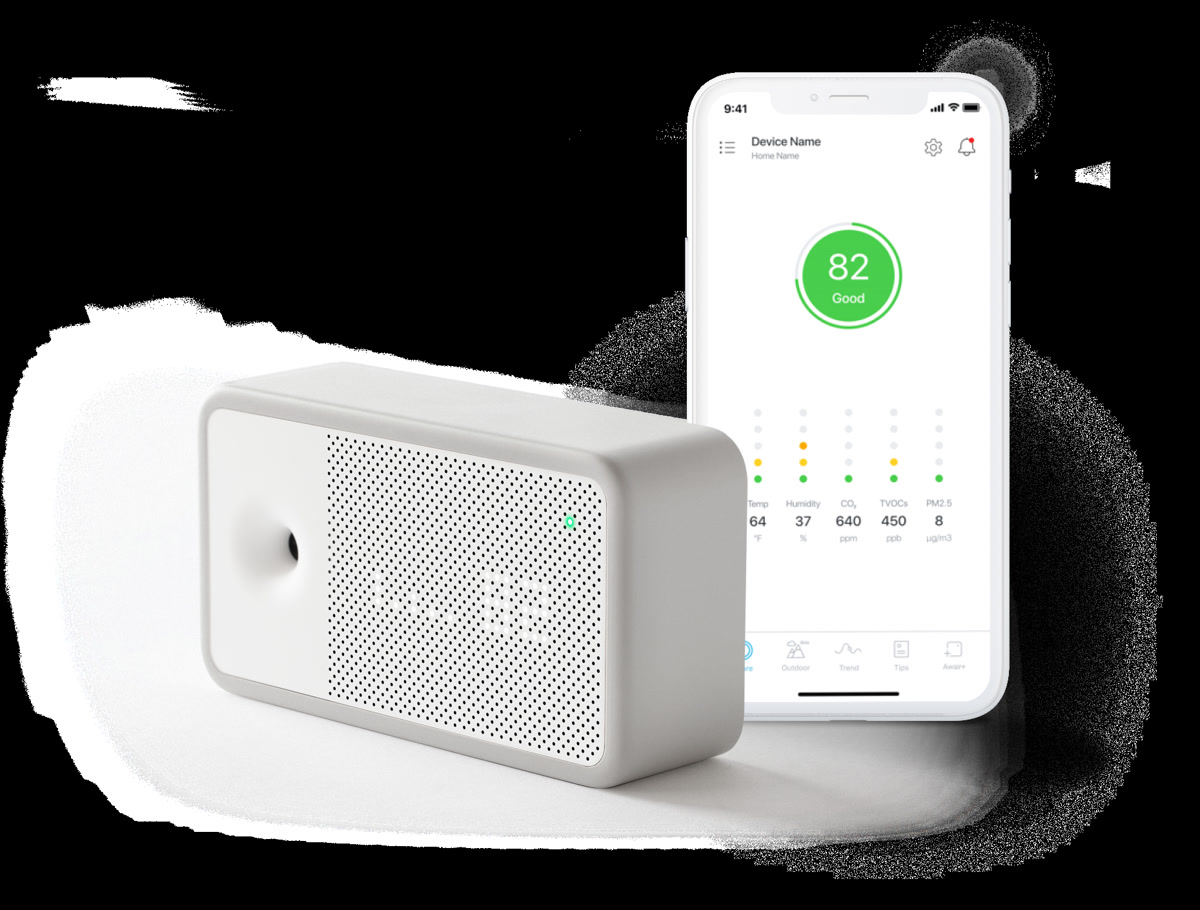
The Awair Element is the device I recommend most often. It measures PM2.5, CO2, VOCs, temperature, and humidity in one unit, scores air quality on a 0-100 scale, and tells you which pollutant is dragging the score down. One in the bedroom and one in the living room covers most homes.
Where it shines is integrations. It works with Alexa, Google Home, and Home Assistant, so when air quality drops, it can trigger other devices: turn on an air purifier, open smart blinds for ventilation, or have your smart speaker announce that air quality is poor. If CO2 climbs above 1000 ppm in your bedroom, the Awair can have your smart speaker announce it. When PM2.5 spikes above 35 in the kitchen (usually from cooking), it can kick on the range hood fan and an air purifier. VOCs jumping past 1500 ppb gets you a phone notification so you know cleaning chemicals or new furniture are off-gassing.
The PM2.5 sensor has a 15 percent margin of error, and CO2 is estimated rather than directly measured (calculated from VOC trends). For most homes, this is more than adequate. I tested it against a dedicated CO2 sensor and the estimates were consistently within 100 ppm. But if you need precise CO2 measurement for a specific reason, pair it with a dedicated CO2 sensor.
The Aranet4: Why I Check It Every Morning
Of all the sensors on this list, the Aranet4 Home changed my daily routine. It is a dedicated CO2 monitor with a non-dispersive infrared (NDIR) sensor — the same technology used in professional air quality testing — accurate to within 50 ppm.
I keep it on my nightstand. In the morning, I check the overnight graph. If CO2 peaked above 1500 ppm during the night, I know my bedroom is too tightly sealed. The fix is simple: crack a window 1 inch or leave the bedroom door open. CO2 drops by 50 percent with even minimal ventilation. After a week of adjusting based on the Aranet4 readings, my sleep improved noticeably. I was waking up groggy with CO2 at 2000 ppm. With a cracked window, it stays under 800 ppm and I wake up clear-headed.
The battery lasts 4 years, so you never need to charge it. The display shows CO2, temperature, and humidity in real time without needing an app. It works entirely standalone, which I appreciate. Connect it to Home Assistant via Bluetooth and you can have your smart speaker announce when CO2 exceeds 1000 ppm, or connect it to a smart window opener or ERV that turns on automatically when CO2 rises. But just looking at the number on the display each morning is enough to change your habits.
Airthings Wave Plus: Radon and CO2 in One
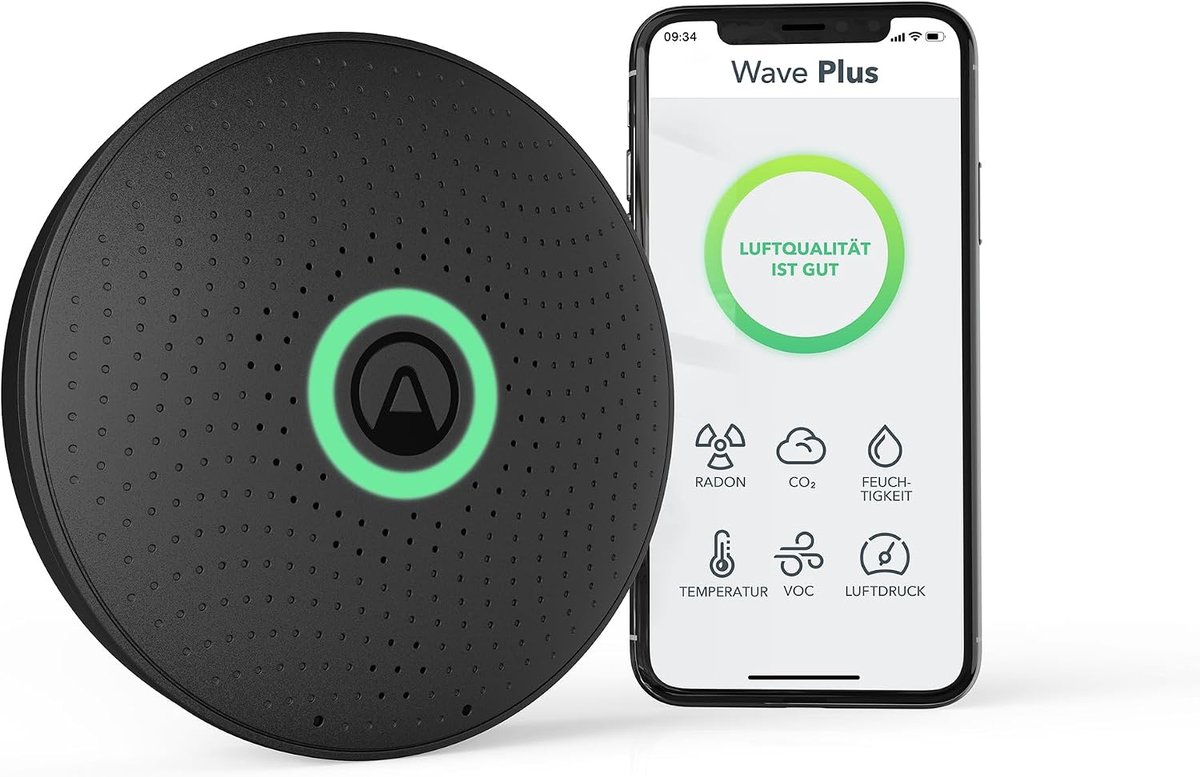
Radon is the pollutant most homeowners ignore because it is invisible, odorless, and takes years to cause harm. But it is the second leading cause of lung cancer after smoking, and one in fifteen homes has elevated levels. The Airthings Wave Plus measures radon, CO2, VOCs, temperature, humidity, and air pressure in one device.
Install it in your basement or lowest living space. Radon enters through foundation cracks and concentrates underground. The Wave Plus takes 24 hours to produce its first radon reading and 7 days for a reliable average. Check the app monthly. If radon averages above 4 pCi/L, install a radon mitigation system (a vent pipe and fan that pulls radon from beneath the foundation and vents it outside). The CO2 sensor is NDIR-based, so it is more accurate than the Awair for CO2 specifically. Pair it with an Awair or PurpleAir for particulate coverage, since it does not measure PM2.5.
PurpleAir PA-II: When Wildfire Smoke Is a Concern
If you live in an area with wildfire smoke, industrial pollution, or high traffic, PM2.5 is the pollutant you need to track most. The PurpleAir PA-II uses a dual laser PM2.5 sensor accurate to within 10 percent of professional equipment — the same technology used by community air quality monitoring networks.
Install one outside your home to monitor outdoor air quality. When outdoor PM2.5 is high (above 35 on the AQI scale), your smart home can close smart windows and blinds, turn on air purifiers, switch HVAC to recirculation mode, and send a phone notification. When it drops below 20, the system reverses: open windows, turn off purifiers. This automation keeps your indoor air clean during smoke events without you checking an app.
Smart Smoke and CO Detector: Non-Negotiable
Carbon monoxide is the one pollutant that can kill you in minutes, not years. Every home with gas appliances, a fireplace, or an attached garage needs a smart CO detector. The First Alert Onelink detects both smoke and CO, sends phone alerts, and integrates with Alexa and Apple Home.
Install one on each floor, plus one in or near any room with a gas appliance (kitchen, basement, laundry room). Replace the entire unit every 7 years — the CO sensor degrades and becomes unreliable after that. Wire it into your smart home so that when CO is detected, the system opens windows automatically (if you have motorized windows or an ERV with exhaust mode), turns off the HVAC to prevent circulating contaminated air, unlocks the front door for emergency responders, and announces through all speakers that carbon monoxide has been detected and everyone should leave immediately.
Ecobee SmartThermostat: Air Quality Built In
Some smart thermostats now include air quality monitoring. The Ecobee SmartThermostat has a built-in air quality sensor that measures PM2.5, VOCs, temperature, and humidity. Paired with Ecobee’s smart sensors placed in other rooms, you get whole-home air quality mapping through one device.
The advantage of using a thermostat for air quality is that it already controls your HVAC system — the most powerful air cleaning tool in your home. When it detects poor air quality, it can run the HVAC fan continuously to circulate air through the filter, switch to a higher MERV filter setting (if your system supports it), activate a whole-home air purifier connected to the ductwork, or adjust humidity levels that affect particulate matter concentration. This is more efficient than standalone monitors because the HVAC system can clean air throughout the entire house, not just one room.
Automation Recipes for Better Air
Once your sensors are in place, a few automations keep the air clean without daily effort:
- Cooking ventilation: When PM2.5 rises above 50 in the kitchen, turn on the range hood fan and kitchen air purifier. Turn off when PM2.5 drops below 25.
- Sleep ventilation: When CO2 in the bedroom exceeds 1000 ppm, announce through the smart speaker to crack a window. If you have a smart window opener or ERV, activate it automatically.
- Wildfire smoke mode: When outdoor PM2.5 exceeds 100, close all smart windows, switch HVAC to recirculation, and turn on all air purifiers. Send a phone notification with the current indoor and outdoor readings.
- Cleaning chemical warning: When VOCs spike above 2000 ppb (common after using bleach, aerosol cleaners, or paint), announce “High chemical levels detected. Open windows for ventilation” and turn on exhaust fans.
- Daily air report: At 8 AM each morning, the smart speaker announces yesterday’s air quality summary: average PM2.5, peak CO2, and whether any thresholds were exceeded.
What It Costs to Build a Complete Setup
A full system looks something like this: two Awair Elements for bedroom and living room (around 300 dollars), an Aranet4 for the bedroom (200 dollars), an Airthings Wave Plus for the basement (250 dollars), a PurpleAir PA-II for outdoor PM2.5 (300 dollars), three First Alert Onelink detectors for one per floor (200 dollars), and a smart thermostat with air quality like an Ecobee (250 dollars).
That comes to roughly 1,500 dollars total. You do not need all of these. The most cost-effective starting point is one Awair Element for 150 dollars and one smart CO detector for 65 dollars. Together, those cover the pollutants most likely to affect your health.
The Two Sensors That Matter Most
Start with a CO2 monitor on your nightstand and a PM2.5 monitor in your kitchen. Those two cover the pollutants most likely to affect your day-to-day life. Most bedrooms have CO2 levels 2 to 3 times higher than they should be, and cooking is the largest source of indoor PM2.5 in most homes. Once you can see the numbers, the fixes are straightforward: crack a window, run the range hood, or set up an automation to handle it for you. The sensors cost less than a single air purifier, and they tell you whether you even need one.
🏠 Get Your Free Smart Home Setup Checklist
Join our newsletter and get this free printable plus weekly tips.