
This article contains affiliate links. We may earn a commission from qualifying purchases.
Some content on this site is AI-assisted and reviewed by our editorial team.
My upstairs neighbor spent a fortune on an Echo Studio, loved it, then spent twice that on four more Studios to cover the house. Whole-home audio hacks exist so nobody does that. The cheap version: one Echo Dot per room you actually listen in ($40-ish each on sale, often $25), grouped in the Alexa app so “Alexa, play Radiohead downstairs” fills the kitchen with sound and the bedroom stays silent. Total for three rooms under $120–150 — less than half of one Sonos Connect-and-speaker setup, and you can stop at any room count you like. Here’s the build from one-room starter to a synchronized whole house, with the honest spots where the cheap path fails.

I ran this setup in three homes over four years. Here’s the gear that makes it work and where it doesn’t.
Echo Dot (5th Gen) — The One-Room Starter
Check the price of the Echo Dot 5th Gen on Amazon

About $50 list, $25–35 on sale · 1.73-inch front-firing driver · tap-top snooze and tap control · built-in temperature sensor
Start here, not with the Studio. The Dot’s single small driver is honest near-field sound — podcasts, radio, acoustic music, kitchen TV replacement all land fine at counter distance. What makes it the starter rather than the compromise: it’s an Alexa hub by existing (routines, timers, intercom-style Drop In between rooms the day you add a second), it can act as a Wi-Fi extender, and the temperature sensor can trigger routines like “fan on when it’s over 78.” When I say the Dot IS the smart home’s starter speaker, that’s not marketing — it’s the cheapest full-participation device Amazon sells.
Con: one small driver, period — no bass response at all; a dot in a big room sounds thin past half volume, and there’s no audio-out jack to wire into anything better.
My take: the single best first smart-home gadget at this price, and the gateway drug to the rest of this post.
Echo Pop — The $40 Full-Sound Budget Room
Check the price of the Echo Pop on Amazon
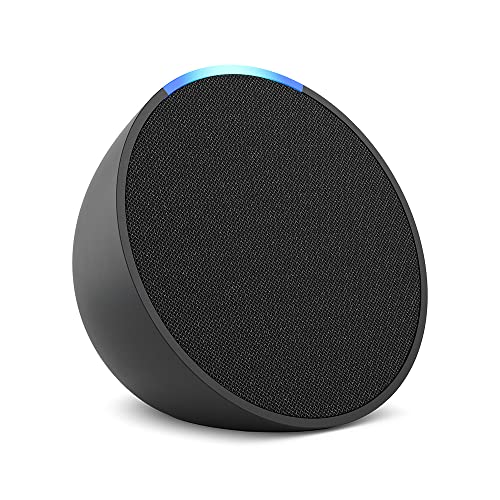
About $40 · 1.95-inch front-firing driver · semi-sphere that tucks anywhere
Amazon’s own budget line and the quiet best-value in the Echo family: a slightly bigger driver in a wedge-shaped package that fits where a Dot’s hockey-puck footprint doesn’t — bookshelf lip, bathroom ledge, garage shelf. Sound is fuller than the Dot (Amazon tunes it slightly louder/warmer per their spec sheets) — think “enough for a bedroom,” not “enough for a party.” In my multi-room run the Pops served the low-priority rooms — bath and garage — and never felt like the weak link.
Con: no temperature sensor and no tap-top controls like the Dot; also no stereo-pairing flexibility — you cannot pair a Pop with a Dot for left/right stereo (it only pairs with its own kind).
My take: the budget room filler — at $35–40 on sale, one per low-priority room beats juggling a single Dot room to room.
Echo Studio (2025) — The Room That Anchors the House
Check the price of the Echo Studio on Amazon
About $220 list, $180 on sale · 3.1.1 spatial audio with Dolby Atmos · built-in Zigbee/Thread/Matter smart-home hub · eero mesh built in (up to ~1,000 sq ft)
One Studio in the main living space is the upgrade the neighbor did RIGHT: spatial audio processing makes it the best-sounding Echo at ordinary volumes, room adaptation tunes itself to placement, and it pulls double duty as a smart-home hub that keeps the rest of your devices off the Wi-Fi bottleneck — with eero radios inside extending your mesh into the dead zone behind it. In a multi-room group the Studio anchors the sound — when everything syncs to “play downstairs,” this is the room that feels like a system, not a speaker group.
Con: at $220 list it costs five Dots, it’s still a big cylinder that wants real shelf space, and the full Atmos experience leans on Amazon Music’s premium tier — on a bare streaming plan it’s an excellent single speaker with unused headroom.
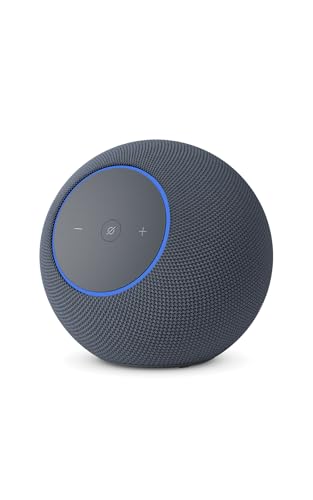
My take: the room where you actually sit deserves the best speaker in the house — one Studio beats three more Dots in the same room every time.
Echo Show 5 (newest) — The Nightstand That Earns Its Slot
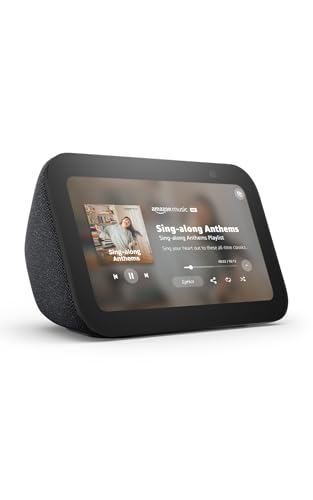
About $99 · 5.5-inch display · 2x the bass of the prior generation · tap-snooze alarm and digital photo frame
The Show 5 is how the audio plan spreads past music: alarm clock that docks your wake-up playlist, kitchen timer at eye level when hands are wet, and the visual layer for the whole setup — doorbell view, weather before feet hit the floor. As a speaker it’s mid-tier, but as the “second room” node it’s better than any puck: the display makes Alexa’s answers visible and usable in places audio-only falls apart (multi-step recipes, guest Wi-Fi handoff).
Con: no built-in Zigbee hub, and the screen is small enough to squint at from across the room — anyone who wants a video doorbell wall panel should step up to the Show 8 or 11.
My take: the nightstand/kitchen counter node that makes the whole-home setup feel finished rather than just loud.
eero 6 Extender — Why Your Group Keeps Dropping
Check the price of the eero 6 extender on Amazon
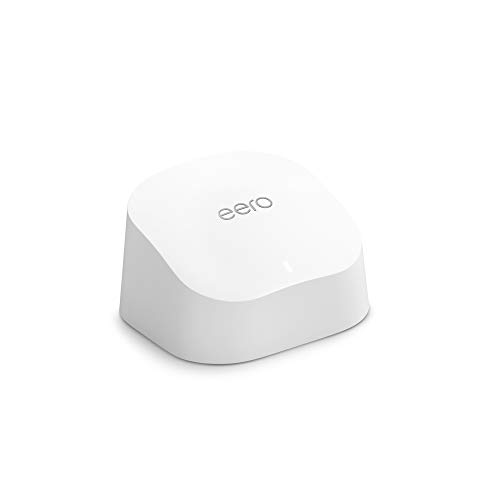
About $80 · extends the mesh by up to 1,500 sq ft · Wi-Fi 6
The failure mode nobody blames on networking: multi-room groups stutter exactly like Wi-Fi, not speakers. Echo devices hop onto the strongest mesh node, and a 5GHz channel that reaches the kitchen fine may barely whisper in the garage — groups then desync at the far end of the house or drop entirely. In every home I ran this in, an eero 6 add-on node in the weak room’s path fixed desyncs that I’d earlier blamed on Alexa itself.
Con: it only makes sense inside an eero system or as a range extender pattern Amazon’s documentation is vague about — if your router is not an eero, a generic Wi-Fi extender in bridge mode solves the same problem for $25.
My take: for eero households this is the whole-home audio fix hiding in the network aisle.
Schlage Encode — Out of Scope but Worth One Line (Wi-Fi Deadbolt)
Check the per-guest codes on the Schlage Encode on Amazon
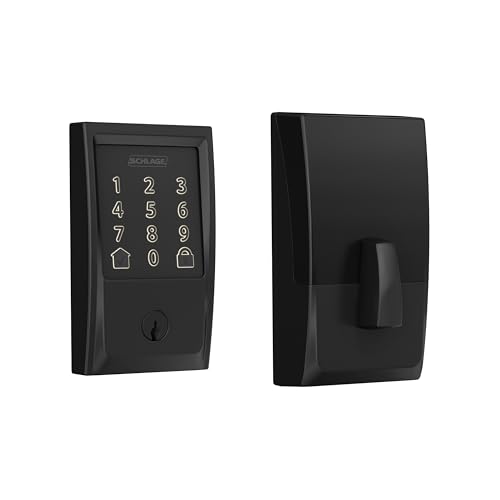
About $219–229 · Wi-Fi built in, no hub · 100 guest codes
Whole-home audio and locks don’t overlap, but here’s why it’s in this post: the Encode is the one-piece answer to the “guest house” half of the multi-room house problem — per-guest codes that expire, no subscription for core function. If you’re already running Echo speakers as your house’s control plane, the Alexa-routine integration completes it: “Alexa, I’m leaving” can re-lock the front door behind you. It’s the Amazon-ecosystem play for the “whole home” promise beyond sound.
Con: Wi-Fi eats the AA batteries, a full deadbolt replacement is a homeowners move and NOT renter-friendly; no HomeKit. And it’s out of this post’s lane — our guest access guide owns the full lock comparison.
My take: skip unless the guest-house problem is real for your house; the audio plan stands alone at under $150 for three rooms.
Amazon devices go cheapest during Prime events — if you’re timing the build, grab a free 30-day Prime trial before the next drop and the Dots land with free shipping too.
What Actually Saves Money (And What Doesn’t)
Dots per room, not Studios per room. The math that actually works: three Dots at $25–35 each deliver 90% of the group-listening experience for the price of one Studio. The Studios only pay you back where you SIT.
Music service choice matters more than speaker count. Multi-room groups work with any service, but free-tier Amazon Music restricts some multi-room features; a single Amazon Music Unlimited plan beats stacking speakers across free tiers.
Wi-Fi before speakers. A $25-generic or $80 eero extender fixes more “broken Alexa” groups than deleting and re-adding devices ever will.
“Stereo pairs” from mismatched speakers don’t exist. Only same-model speakers can stereo-pair — so plan rooms as one-model-per-room.
Sidewalk is worth a look. It shares a sliver of bandwidth with neighbors; if privacy outweighs community benefit for you, turn it off in the app—the audio system doesn’t need it.
The Savings Math
Budget build (3 rooms): 3x Echo Dot at $25–35 on sale = $75–105 all-in — versus $450+ for a Sonos two-zone starter — saves about $350.
Balanced (4 rooms): 3 Dots + 1 Studio ~= $180–205 — the main room gets real sound, the rest get real Alexa.
With displays: add the Show 5 ($99) for the nightstand — alarm, doorbell view, timers; the multi-room group still includes it.
The bedroom automation play ties in neatly—see my bedroom automation guide for night routines, and the smart-home privacy checklist for the Echo account settings worth auditing the same week you add speakers.
CleverHomeClub is reader-supported. As an Amazon Associate, I earn from qualifying purchases. That means if you buy through one of the links above, I get a small commission at no extra cost to you. I only recommend devices I’d run in my own home.
🏠 Get Your Free Smart Home Setup Checklist
Join our newsletter and get this free printable plus weekly tips.
Price Check
Prices verified via our product tracker. Updated Sep 27.
| 2022 Echo Dot 5th Gen Smart Speaker | Charcoal | Amazon | $39.99 | 4.7★ (200,120) |
| Echo Pop | Full sound compact smart speaker with Alexa | C | $219.99 | 4.7★ (103,753) |
| Amazon.com: Amazon Echo Show 5 (newest model), Smart displ | $99.99 | 4.2★ (72,396) |
| Amazon.com: Amazon eero 6 mesh wifi add-on extender - Add | $79.99 | 4.4★ (29,429) |
| Schlage Encode Smart WiFi Deadbolt Lock with Century Trim, | $229.00 | 4.2★ (13,273) |
As an Amazon Associate we earn from qualifying purchases.