This article contains affiliate links. We may earn a commission from qualifying purchases.
Some content on this site is AI-assisted and reviewed by our editorial team.
Smart sprinkler controllers are one of the few smart home devices that literally pay for themselves. The EPA estimates that half of the water homeowners use outdoors is wasted by inefficient watering, and a smart controller can cut that waste by 30 percent or more. But with prices ranging from 70 to 250 dollars, which ones actually deliver on the promise?
I tested and compared the four controllers worth considering in 2026, from budget-friendly picks to full-featured irrigation computers. Here is what each one does well, where they fall short, and which one makes sense for your yard.

How Smart Sprinkler Controllers Actually Save Water
Traditional sprinkler timers run on a fixed schedule regardless of weather. Rain or shine, they turn on at 6 AM because that is what the dial says. Asmart sprinkler controller replaces that dumb timer with real-time weather data, soil moisture readings, and plant type algorithms that adjust watering automatically.
Here is how the savings break down:
- Weather skip — The controller checks forecasts and skips watering when rain is expected or just happened. This alone can save 20 to 40 percent of outdoor water use.
- Seasonal adjustment — As temperatures and daylight hours change, the controller scales watering up or down instead of running summer schedules in October.
- Zone-by-zone tuning — You tell the controller what type of plants are in each zone (grass, shrubs, flowers, vegetables) and it calculates the right amount of water for each one instead of blasting everything equally.
- Soil and slope awareness — Advanced controllers factor in soil type and slope to prevent runoff, applying water in short cycles so it soaks in rather than running down the driveway.
The typical American household spends about 170 dollars per year on outdoor water. If a smart controller saves 30 percent, that is roughly 50 dollars a year. A 150-dollar controller pays for itself in about three years, and many utilities offer rebates that cut the payback period to under a year.
What to Look For in a Smart Sprinkler Controller
Before getting into specific picks, here are the features that actually matter:
- Zone count — Count the number of valve zones in your current system. Most homes need 4 to 8 zones. Buy a controller with at least one more zone than you currently use so you can expand later.
- Weather source — Controllers that use local weather stations (not just zip-code forecasts) make better watering decisions. Rachio and Netro pull from networks of thousands of stations; budget controllers may rely on a single nearby airport reading.
- Wi-Fi reliability — If your controller is in a garage or basement with weak Wi-Fi, look for one with Ethernet or a Wi-Fi extender option. A disconnected controller reverts to dumb-timer mode.
- Integration — Alexa and Google Home support lets you start or stop zones by voice. Home Assistant users should check for local API or MQTT support.
- Rebate compatibility — Many water districts requireEPA WaterSense certification to qualify for rebates. Rachio and B-hyve both have it; some budget controllers do not.
The 4 Smart Sprinkler Controllers Worth Buying
1. Rachio 3 (150 to 230 Dollars)
TheRachio 3 is the controller most people should buy. It has the best weather intelligence in the category, the most polished app, and the widest rebate eligibility. The 8-zone model covers most suburban yards, and the16-zone Rachio 3 handles larger properties.
- 8 or 16 zones
- Weather Intelligence Plus uses hyper-local data from over 300,000 weather stations
- Catch cup testing mode for measuring actual sprinkler output per zone
- Works with Alexa, Google Home, HomeKit, and Home Assistant
- EPA WaterSense certified (qualifies for most rebates)
- Wi-Fi and Ethernet
The good: Setup is guided and genuinely easy. The app walks you through zone-by-zone configuration with plant type, soil type, slope, and sun exposure. Weather skip works reliably. The catch cup feature lets you calibrate your system precisely rather than guessing.
The catch: It is the most expensive option. The app requires an account, and while there is no subscription, you are relying on Rachio’s cloud for weather data. If your internet goes out, the controller falls back to a basic schedule.
Best value:Rachio 3 8-Zone (Compare prices on Amazon) — the smart irrigation gold standard if your yard has 8 zones or fewer.
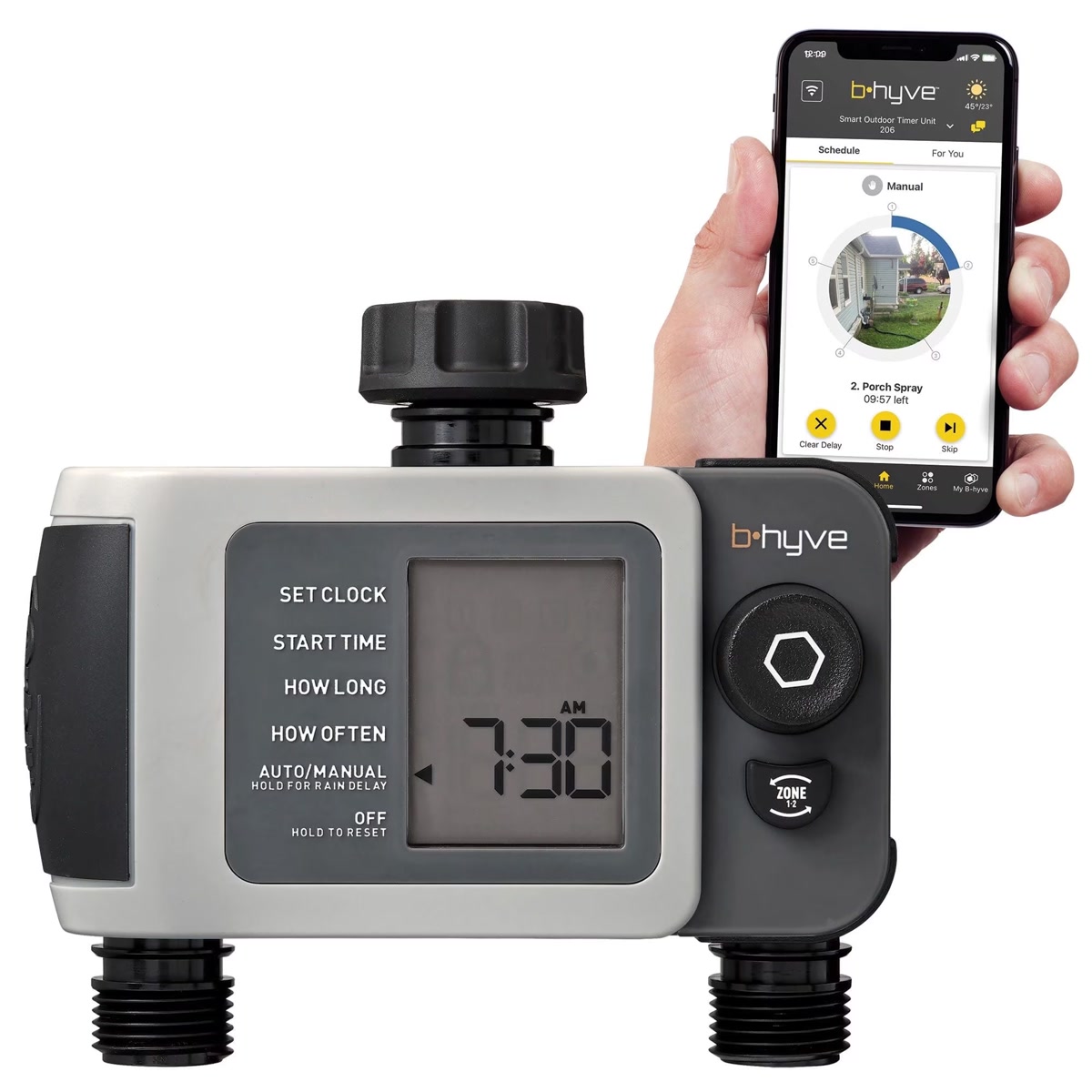
2. Orbit B-hyve 6-Zone (70 to 90 Dollars)
TheOrbit B-hyve 6-Zone is the budget pick that still does the important things right. It uses WeatherSmart technology to adjust watering based on forecasts, and it costs half as much as the Rachio 3.
- 6 or 12 zones available
- Indoor and outdoor rated housing
- WeatherSmart watering adjusts based on forecast
- Works with Alexa and Google Home
- EPA WaterSense certified
- Wi-Fi only (no Ethernet)
The good: At around 70 dollars, the B-hyve delivers weather-based watering for less than half the price of premium controllers. The outdoor-rated housing means you can mount it right next to your valves without a separate enclosure. Rebate eligibility softens the price even more.
The catch: The app is functional but not as intuitive as Rachio’s. Zone configuration is less granular — you pick a general zone type rather than specifying soil, slope, and sun exposure individually. Weather data comes from fewer stations, so skip accuracy is slightly lower in areas far from airports.
Best value:B-hyve 6-Zone (Compare prices on Amazon) — the best budget option that still qualifies for water rebates.
3. Netro 6-Zone (90 to 120 Dollars)
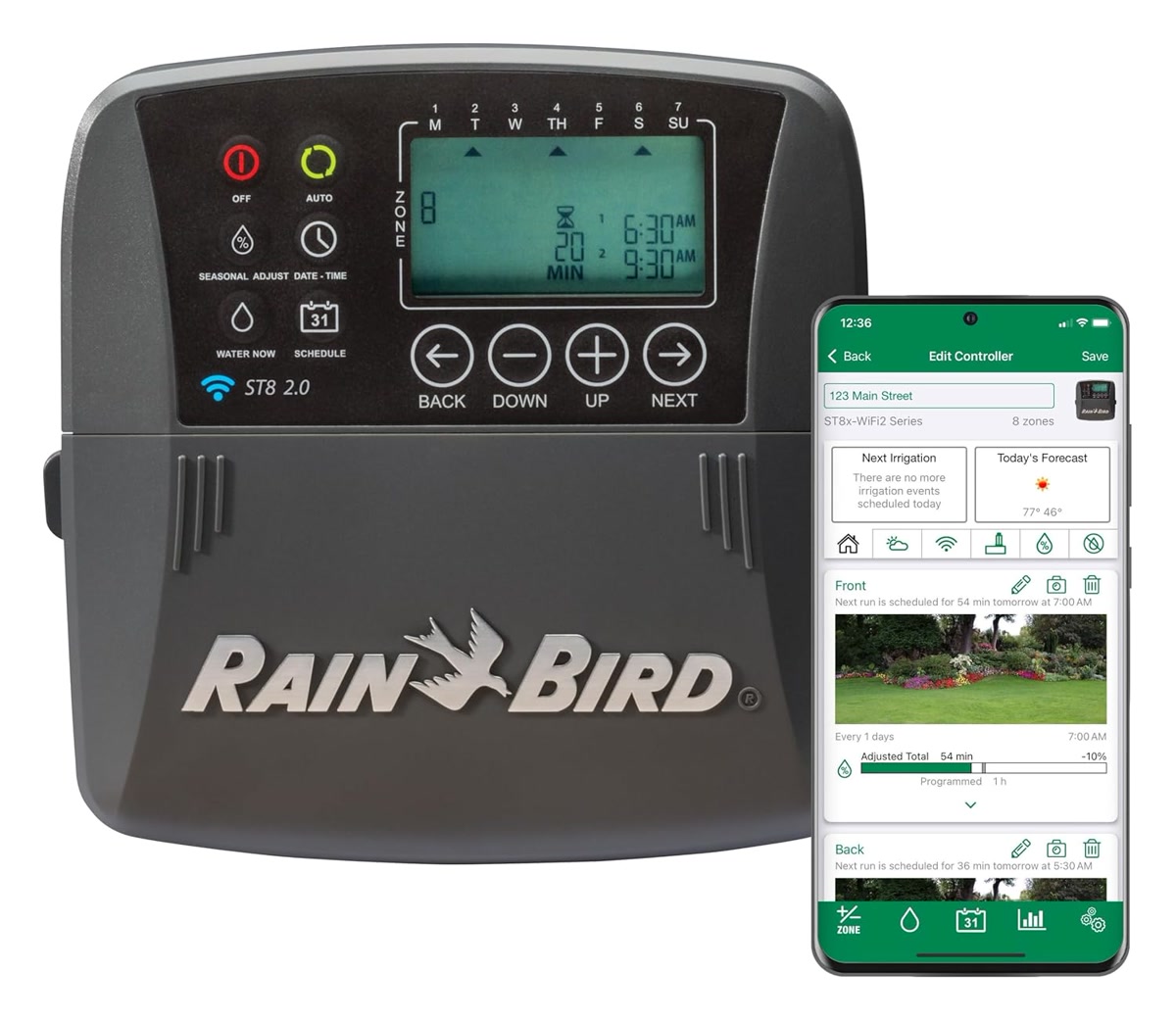
TheNetro 6-Zone sits between the B-hyve and Rachio in both price and capability. Its standout feature is the optionalNetro Whisperer soil moisture sensor, which measures actual ground moisture instead of relying entirely on weather data.
- 6 or 12 zones
- Optional soil moisture sensor for zone-level watering decisions
- Natural watering algorithm mimics natural rainfall patterns
- Works with Alexa
- Water restriction compliance built in
- No subscription required
The good: The soil moisture sensor is a real differentiator. Instead of guessing how much water your lawn needs based on a weather station miles away, the sensor tells the controller exactly how dry the soil is. The natural watering algorithm applies water in cycles that match how soil absorbs moisture, reducing runoff.
The catch: The app is less polished than Rachio’s. Integration options are limited — no HomeKit and no Home Assistant support out of the box. The controller requires 24 VAC from your existing transformer, so it is not a simple swap for battery-powered timers.
Best value:Netro 6-Zone (Compare prices on Amazon) — the best pick if you want soil moisture data driving your watering schedule.
4. Orbit B-hyve XR 8-Zone (100 to 130 Dollars)
TheB-hyve XR is the step-up Orbit model with a color touchscreen, better build quality, and more programming flexibility than the base B-hyve.
- 8 or 16 zones
- Color touchscreen for manual control without the app
- WeatherSense with freeze and wind skip
- Works with Alexa and Google Home
- EPA WaterSense certified
- Indoor and outdoor rated
The good: The touchscreen means you can adjust schedules without pulling out your phone, which matters more than you think when you are standing at the controller with wet hands. Wind skip is useful in dry climates where spray drift wastes water. The XR feels more like a proper irrigation computer than the budget B-hyve.
The catch: The app experience is the same as the base B-hyve — Orbit does not give the XR a separate, more capable app. At 100-plus dollars, it competes with Netro on price, and Netro’s soil sensor option makes a stronger case for spending a little more.
Best value:B-hyve XR 8-Zone (Compare prices on Amazon) — the best pick for people who want a physical display and wind skip in a budget package.
How Much Water Can You Actually Save?
The EPA WaterSense program certifies controllers that can demonstrably save water. According to their testing, certified smart controllers reduce outdoor water use by an average of15 to 30 percent. In dry climates with large yards, savings can hit 40 percent.
Here is a rough savings estimate based on yard size:
- Small yard (4 zones, 2,000 sq ft): 30 to 60 dollars saved per year
- Medium yard (6 to 8 zones, 5,000 sq ft): 60 to 120 dollars saved per year
- Large yard (12+ zones, 10,000+ sq ft): 120 to 250 dollars saved per year
Add in utility rebates (many offer 50 to 150 dollars for installing a WaterSense-certified controller), and the payback period for most setups is 1 to 3 years. After that, the savings are money in your pocket every year.
Installation: Easier Than You Think
Swapping a dumb timer for a smart controller takes about 30 minutes if your existing wiring is in good shape. Here is the basic process:
- 1. Label your wires. Before disconnecting anything, tag each wire with the zone number it controls. Most controllers use one common wire and one wire per zone.
- 2. Disconnect the old controller. Unscrew the wires from the terminals and remove the old unit from the wall.
- 3. Mount the new controller. Use the included mounting hardware. Indoor controllers need a dry location; outdoor-rated models can go right next to your valves.
- 4. Connect the wires. Match each labeled wire to the corresponding zone terminal. Connect the common wire to the C terminal.
- 5. Connect to Wi-Fi and set up zones. Download the app, follow the pairing process, and configure each zone with plant type, soil, and sun exposure.
If your valve wires are damaged or you do not have an existing 24 VAC transformer, you may need an irrigation professional to get things running. Most homeowners can handle the swap themselves.
Smart Sprinkler Controllers and Water Rebates
Before you buy, check your local water utility’s website for rebate programs. Many offer substantial incentives:
- Fixed rebates: Commonly 50 to 150 dollars per controller
- Performance rebates: Some utilities pay based on actual water savings, which can be even higher
- Requirements: Most rebates require an EPA WaterSense-certified controller, professional installation, or proof of purchase
Rachio and B-hyve both maintain rebate lookup tools on their websites. Enter your zip code and they will show you available programs in your area. A 150-dollar Rachio 3 with a 100-dollar rebate is effectively a 50-dollar investment that saves 50-plus dollars per year.
Bottom Line
Smart sprinkler controllers are one of the rare smart home devices that generate a measurable return on investment. They save water, they save money, and many utilities will pay you to install one. TheRachio 3 is the best overall pick for its weather intelligence, app quality, and broad integration support. TheB-hyve 6-Zone gets you 80 percent of the functionality at half the price. And theNetro with its soil moisture sensor is the most scientifically accurate option for people who want their lawn watered based on what the ground actually needs, not what a weather station three miles away thinks.
Whatever you choose, check for rebates first. The difference between full price and a rebated controller can be the difference between paying for itself in one season versus three.
n
🏠 Get Your Free Smart Home Setup Checklist
Join our newsletter and get this free printable plus weekly tips.